
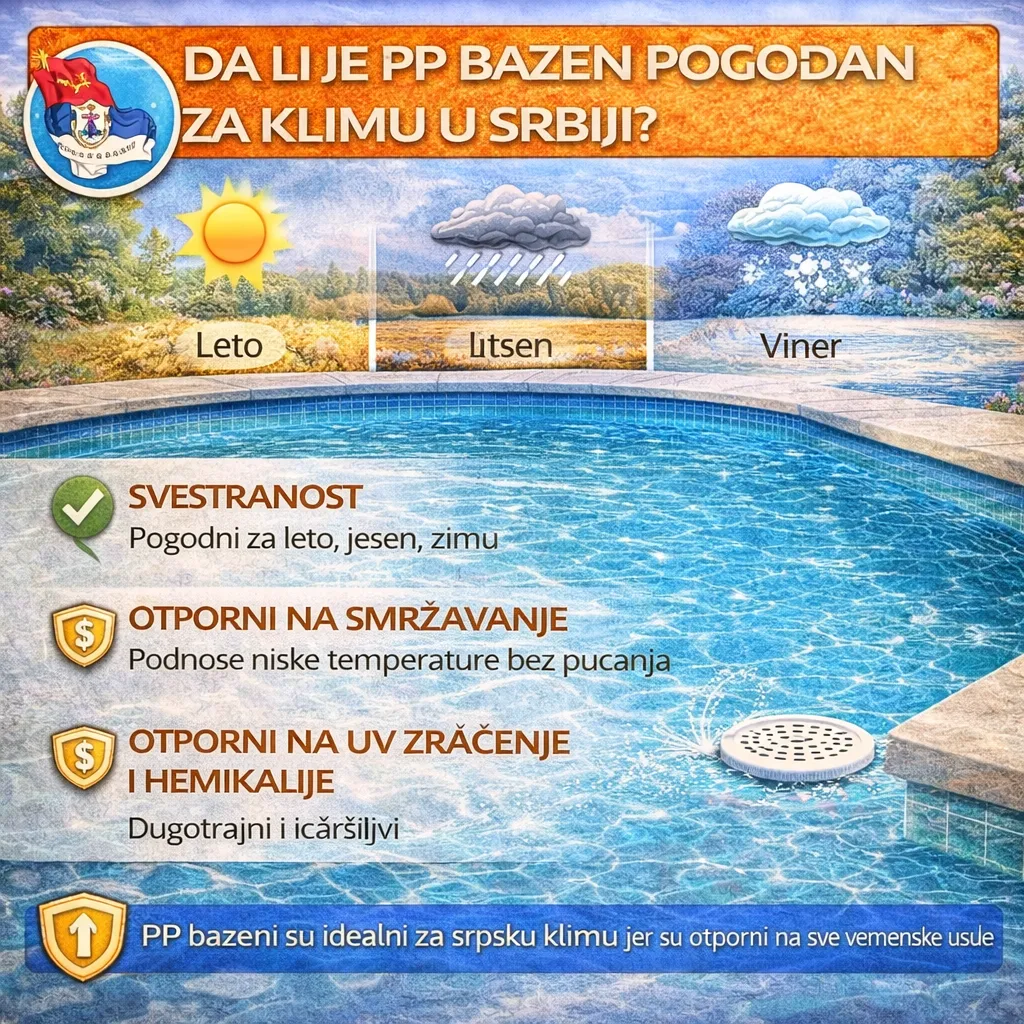
The short answer: yes – a PP (polypropylene) pool is very suitable for Serbia’s climate, with one important condition: it must be professionally manufactured and installed, with a properly prepared base, drainage, insulation, and correct winterization. Serbia’s climate has clear specifics: hot summers with strong UV exposure, transitional seasons with large temperature swings, and winters with frost, freezing, and occasional snow. A well-built PP system is designed to handle exactly that.
In local conditions, the biggest “enemy” is not summer – it’s the combination of moisture, groundwater, and frost during the period when the pool is not in use. That’s why suitability is not only about the material, but about the entire system around the shell.
Summer conditions: heat and UV exposure
In summer, a PP pool is exposed to high temperatures and intense sunlight. In practice, UV stabilization of the material is important, especially around the waterline and on steps/shallow zones that often sit in bright sun. High-quality PP sheets with proper UV stabilization handle these conditions well, together with normal water care.
Another practical summer topic is water temperature: in many backyards the water warms up quickly. If you want controlled comfort and a longer season, proper insulation and suitable heating make a major difference.
Spring and autumn: temperature swings and season extension
During transitional seasons, day–night temperature swings are common. A PP pool is an excellent base for extending the season, especially with good insulation and heating (for example a heat pump). Insulating the bottom and side walls reduces heat loss so the water cools down more slowly. In real terms, that means more usable days and more efficient heating costs.
Winter conditions: frost, freezing, and a “resting” pool
Winter is the key topic in Serbia. PP as a material handles low temperatures well, but the system must be prepared so freezing does not damage water systems and equipment. The most important part is correct winterization:
lowering the water level according to the system design (in relation to skimmers and plumbing),
draining and protecting plumbing and equipment (pump, filter, heaters, pipes),
using floats/ice compensators or similar solutions to relieve ice pressure,
starting winter with stable, clean water (not with an existing problem),
a cover (if used) to reduce dirt and simplify spring opening.
Ice expansion is what typically “breaks things” – most often equipment and plumbing, not the shell. That’s why the focus is on correct system preparation rather than fear of the PP material itself.
Groundwater and drainage: a reality in many yards
In Serbia, groundwater levels can change across the year. Spring often brings more water in the soil, and autumn can bring heavy rainfall. If drainage is not solved, moisture and pressure around the pool can create problems for any pool system. With PP pools, professional drainage and correct backfilling are essential for long-term stability.
When drainage is done properly, the pool stays stable even in wet periods and the structure is not exposed to unnecessary stress.
Insulation: comfort and efficiency in local conditions
Insulation matters a lot in Serbia because it’s the difference between a pool used “only in July and August” and a pool that can realistically be used much longer. Bottom insulation (e.g., XPS) and side insulation (e.g., EPS) reduce heat loss, stabilize water temperature, and reduce heating load. Insulation also supports a smoother thermal behavior during temperature swings.
What to pay attention to for maximum reliability in Serbia
UV-stabilized PP material and quality sheets with appropriate thickness.
Excellent welds and proper quality control.
Correct base and leveling – no improvisation.
Drainage designed for the specific site (groundwater, rainwater).
Insulation of the bottom and sides for comfort and energy efficiency.
Proper winterization to protect plumbing and equipment from frost.
Conclusion
A PP pool is very suitable for Serbia’s climate: it handles summer heat and UV, performs well in transitional seasons with insulation and heating, and remains safe in winter when the system is properly prepared and winterized. As with everything in pool building, long-term reliability is not “only the material,” but the quality of fabrication, installation, and maintenance – and a professionally executed PP system fits local conditions extremely well.