
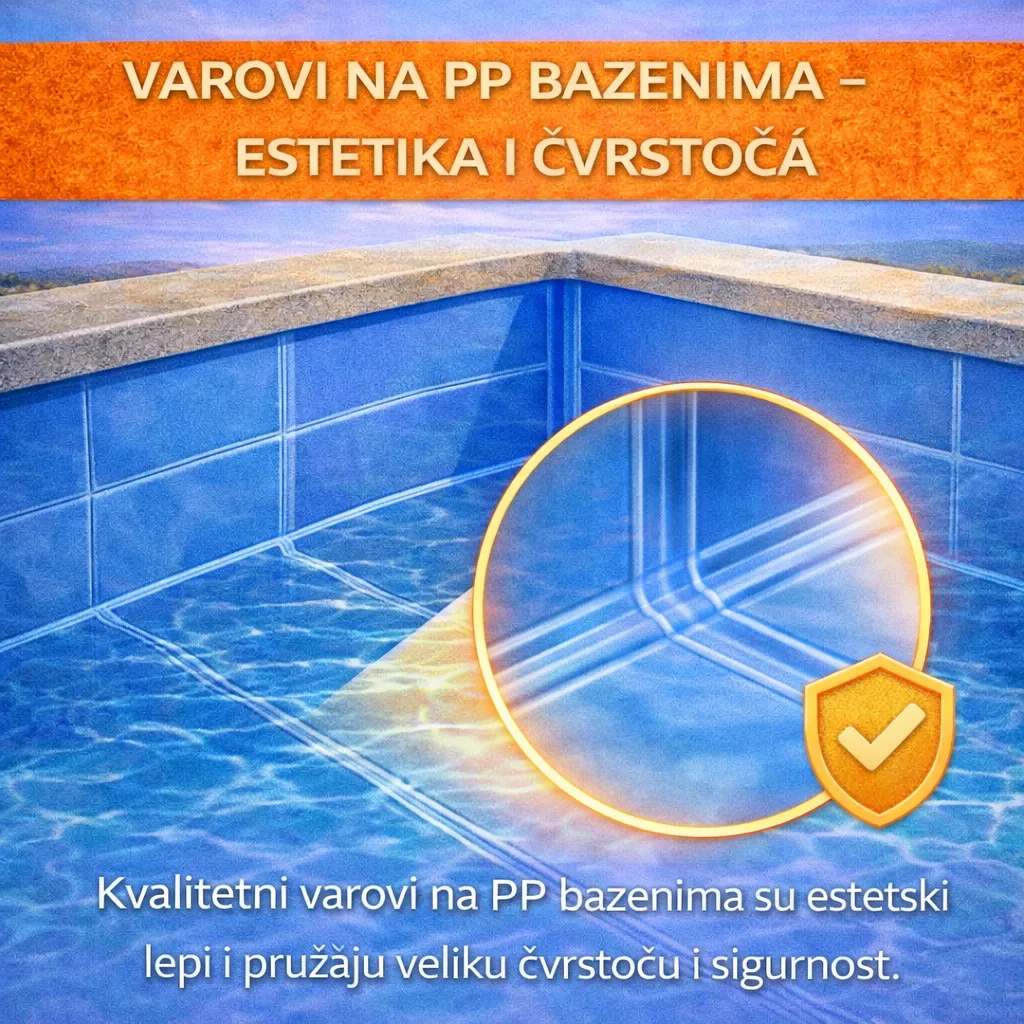
Welds are one of the most important elements of any PP (polypropylene) pool. They are not merely joints between sheets, but a critical part of the structure that ensures watertightness, mechanical stability, and long service life. The quality of welds directly affects both the aesthetics and the strength of the pool shell.
Why are welds critical in PP pools?
A PP pool is made from multiple sheets joined by welding into a single homogeneous structure. Unlike adhesive bonding or mechanical fastening, welding creates joints with the same or very similar properties to the base material. If a weld is poorly executed, it becomes a potential weak point regardless of the quality of the sheets themselves.
Internal and external welds
In PP pools there are two principal categories of welds:
Internal welds – visible from inside the pool; they affect aesthetics and ease of maintenance.
External welds – structural welds that carry the load and ensure the strength of the shell.
Aesthetics of welds
A good weld is uniform, of consistent width, and with a smooth transition. Aesthetics is not merely a visual matter — a neatly executed weld usually indicates that temperature, speed, and pressure during welding were correct. Irregular, "wavy", or burnt welds frequently point to errors in the process.
Weld strength and performance
A strong weld must be fully bonded to both PP sheets, without pores, voids, or discontinuities. Such a weld withstands water pressure, soil loads, and the thermal expansion of the material. When the sheets and welding rod are of the same type and are properly welded, the weld does not represent a weaker point than the rest of the structure.
Welding technique and its effect on quality
Weld quality depends on several factors: tool temperature, welding speed, pressure, cleanliness of the material, and operator experience. Professional welding yields consistent results, whilst improvisation frequently leads to hidden problems that may only manifest after several seasons.
Most common welding defects
overheating of the material and degradation of the PP,
insufficient heating resulting in a weak joint,
incompatible welding rod,
inconsistent welding speed,
poor edge preparation.
How to recognise quality welds
a uniform line without interruptions,
consistent texture throughout,
no visible pores or cracks,
good fusion with the base material.
Conclusion
Welds in PP pools are both a technical and an aesthetic element. A good-looking weld is usually also a good weld, but the true value is revealed in the strength and longevity of the joint. Quality welding, combined with good materials and correct structural design, guarantees that a PP pool will be stable, watertight, and reliable for many years to come.