
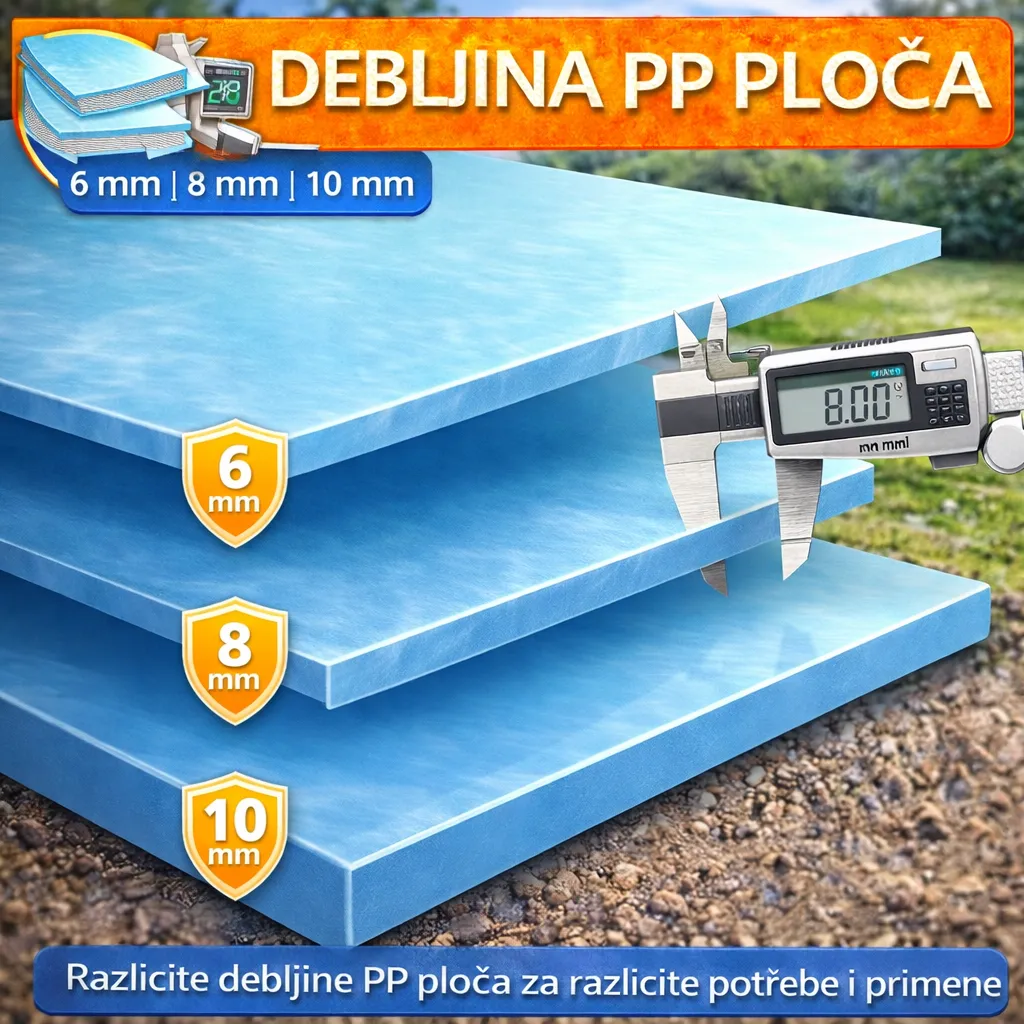
The thickness of PP (polypropylene) sheets is one of the key factors that directly affects the stability, durability, and long-term performance of a PP pool. There is no single "ideal thickness" for every pool — the right choice depends on the pool dimensions, depth, structural concept, reinforcement design, and installation method.
In practice, PP pools most commonly use sheets of 6 mm, 8 mm, and 10 mm, each with its own logic and purpose.
6 mm PP sheets
6 mm PP sheets are used for smaller pools, shallower structures, or secondary elements. They are easier to handle and weld, but have lower rigidity compared to thicker sheets.
suitable for smaller pools and simple shapes,
more commonly used for steps, benches, and internal elements,
require closer and correctly sized reinforcements,
not recommended as the primary material for large or deep pools.
8 mm PP sheets
A thickness of 8 mm represents the most common compromise between strength, flexibility, and cost. This is the standard thickness for a large proportion of residential PP pools.
good mechanical stability with properly designed ribs,
suitable for medium and larger pools,
handles water pressure and soil loads well,
the most common choice for pool walls and floors.
10 mm PP sheets
10 mm PP sheets are used for larger or deeper pools, or where additional strength and stability reserves are required. This thickness provides a more robust structure, but demands more material and more substantial processing.
high rigidity and structural stability,
suitable for deep pools and walls with longer spans,
lower sensitivity to localised stress,
greater weight and higher material cost.
Is a thicker sheet always a better solution?
Not necessarily. Sheet thickness must be part of an overall structural system. Poorly designed ribs, poor installation, or inadequate drainage cannot be "corrected" simply by using thicker material. A correctly designed PP pool uses the optimum sheet thickness in combination with reinforcements and proper installation.
How is the correct thickness selected?
pool dimensions and depth,
rib spacing and type of reinforcement,
soil conditions and presence of groundwater,
installation method and backfilling approach,
the contractor's experience and standards.
Conclusion
Thicknesses of 6 mm, 8 mm, and 10 mm each have their place in PP pool construction. The key is not always to use the thickest sheet, but to select the optimum thickness in accordance with the design. When the material, reinforcements, and installation are properly matched, a PP pool achieves both stability and a long service life.