
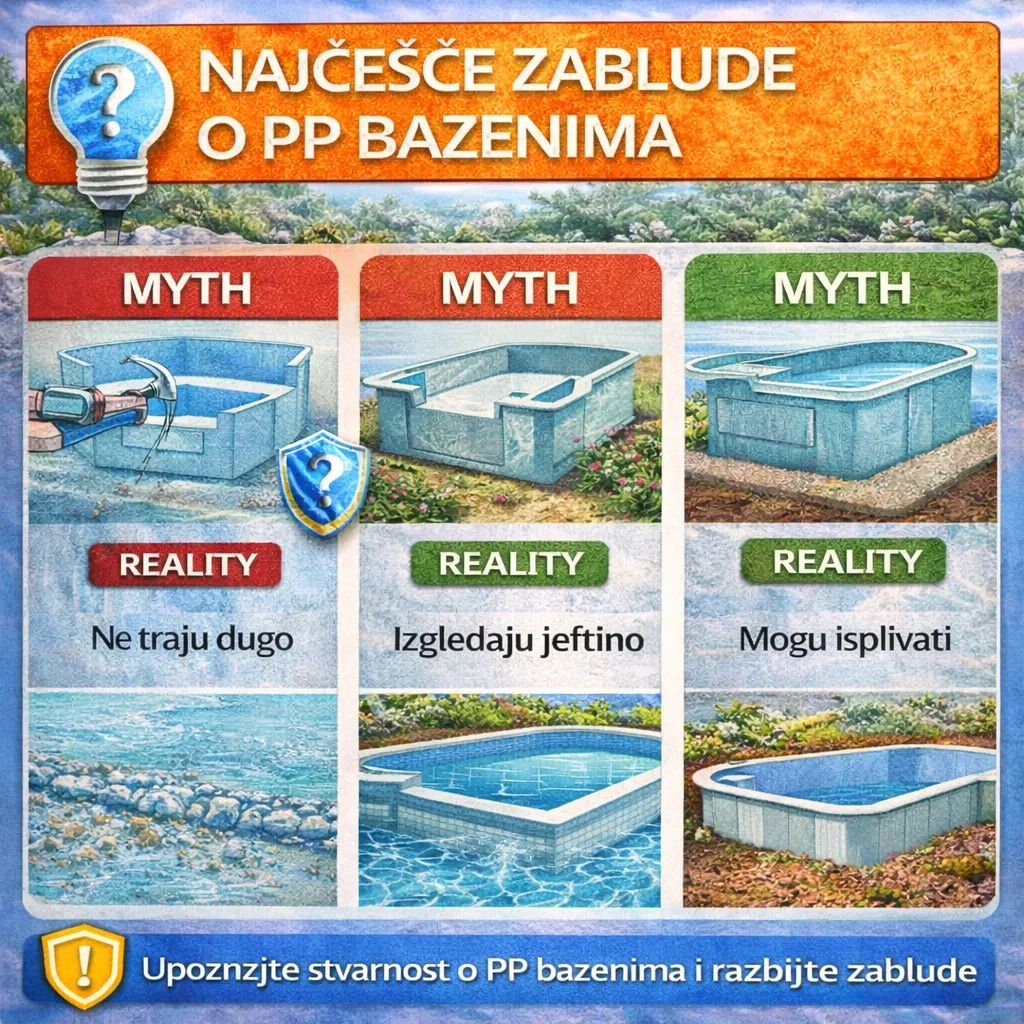
PP (polypropylene) pools have become increasingly popular, so it’s normal that many “stories” circulate – some from lack of knowledge, some from bad experiences with poorly built pools, and some from comparing PP to completely different systems. The problem is that myths create wrong expectations: someone assumes PP “can’t last,” someone believes “all PP pools are the same,” and someone expects a pool can be installed without serious site preparation.
Below are the most common myths and the real explanation – without marketing and without exaggeration. A PP pool is an excellent system, but like any serious product, it depends on fabrication and installation quality.
Myth 1: “A PP pool is just a plastic tub”
A PP pool is not an improvised “tub,” but a structural product. The shell is formed by welding PP sheets into a single unit, with reinforcements and details that carry the loads of water and surrounding soil. When properly engineered and installed, a PP pool is a stable system – not “thin plastic.”
Myth 2: “PP is bad because it’s plastic”
The word “plastic” often sounds cheap, but polypropylene used for pools is not the same as low-grade plastics people imagine. PP is a chemically stable thermoplastic, it does not absorb water, and it handles standard pool chemistry well. The real quality comes from sheet grade, UV stabilization, thickness, and correct welding.
Myth 3: “All PP pools are the same”
This is one of the most dangerous misconceptions. The difference between a top-tier PP pool and an average one is huge and is usually found in details: sheet quality, welds, reinforcements, base preparation, drainage, insulation, and correct backfilling. Two pools can look similar in photos and behave completely differently over time.
Myth 4: “PP always fades and ‘burns’ in the sun”
Fading and surface aging are most often caused by lower-quality material without proper UV stabilization, extreme water chemistry, or poor maintenance. High-quality UV-stabilized PP, combined with stable water parameters, offers good resistance to outdoor exposure. Normal signs of use can appear over years, but “burning” is not a rule – it’s a symptom of poor material or poor conditions.
Myth 5: “PP pools can’t handle Serbian winters”
PP as a material handles low temperatures well. Winter problems, when they occur, usually come from incorrect winterization: water trapped in plumbing, equipment not drained, skimmers not protected, or ice pressure on components and pipes. The issue is not “PP,” but system preparation. With proper winterization, a PP pool is safe in local conditions.
Myth 6: “If the shell is good, installation is not that important”
Installation is as important as fabrication. A poor base, incorrect leveling, missing drainage, wrong backfilling, or ignoring groundwater can create problems even for a perfect shell. A PP pool is a system: shell + site + installation + equipment. If one link fails, the consequences show up over time.
Myth 7: “A PP pool can’t be premium or luxurious”
PP pools can look very modern and “premium,” especially when details are designed well: integrated steps, benches, shallow zones, clean lighting, well-planned surroundings, and quality coping and decking. Luxury does not come from the “material alone,” but from the project, details, and the finishing of the environment.
Myth 8: “PP doesn’t tolerate chlorine or pool chemicals”
PP performs well with standard pool chemistry when water balance is kept stable. Problems come from extremes: very low or very high pH, overly aggressive dosing, uncontrolled shock treatments, or long periods of neglected water balance. Stable water protects both the shell and the equipment, regardless of the disinfection system.
Myth 9: “PP pools can’t be repaired”
PP is a thermoplastic and it can be welded. That means that if local damage occurs or modifications are needed, professional repair methods exist. Of course, the goal is to avoid repairs, but the claim that PP “cannot be repaired” is not true.
Myth 10: “The most important thing is to build the cheapest pool”
With pools, mistakes are the most expensive part. A pool is a system expected to work for years, and quality upfront often means peace later. Saving in the wrong places (undersized equipment, weak insulation, poor drainage, bad installation) almost always costs more in the long run. The best logic is to invest in a quality shell, correct installation, and properly sized equipment.
Conclusion
Most myths about PP pools appear when people mix high-quality and low-quality implementations in the same category. A PP system can be extremely reliable, durable, and attractive, but it requires professional fabrication and installation. When material, welds, reinforcements, base preparation, drainage, insulation, and equipment are done correctly, a PP pool delivers an excellent balance of comfort, stability, and long-term costs.