
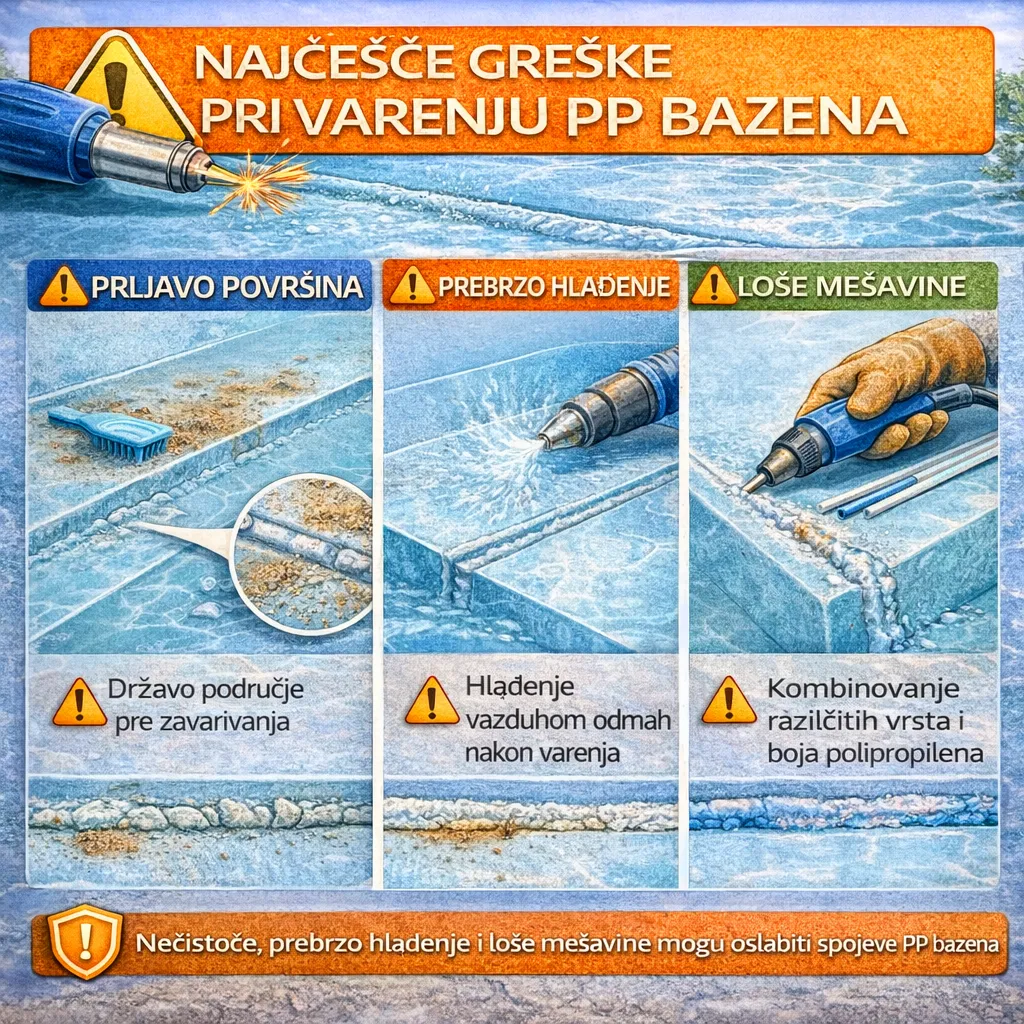
Most common mistakes when welding PP pools
Welding is a critical phase in the fabrication of a PP (polypropylene) pool. Although PP material is relatively straightforward to weld, errors in technique, preparation, or execution can lead to serious problems — ranging from cosmetic defects to structural weaknesses and leaks. The greatest challenge is that many mistakes are not immediately visible, but only manifest after one or more seasons of use.
Insufficient or excessive welding temperature
If the temperature is too low, the weld does not fuse properly with the base material and remains weak. If the temperature is too high, PP degradation occurs, leading to loss of elasticity and brittleness. Both situations produce a weld that is not reliable in the long term.
Poor edge preparation
The edges of PP sheets must be clean, dry, and correctly shaped. Dust, grease, or improper bevelling leads to an incomplete joint and the formation of micro-voids within the weld.
Incompatible welding rod
The welding rod must be of the same material type as the sheets (most commonly PP-R). Using an inappropriate rod results in a weak chemical and mechanical bond.
Uneven welding speed
Welding too quickly does not allow the material to fuse correctly, whilst welding too slowly can cause overheating. The result is welds of inconsistent quality.
Insufficient material in the weld
A weld that is too shallow or contains insufficient filler material reduces the load-bearing capacity of the joint, particularly at structural welds that are subject to stress.
Incorrect welding sequence
An improper welding sequence can lead to internal stresses, warping of sheets, and deviations in the geometry of the pool shell.
Absence of external structural welds
Relying solely on cosmetic internal welds, without strong external welds or extrusion welding, is a common and serious mistake in poor-quality pools.
Insufficient quality control
The absence of visual and technical inspection after welding means that defects remain hidden until the pool is put into service.
Conclusion
The most common mistakes when welding PP pools are not caused by the material, but by failure to follow correct procedures and a lack of experience. Quality welding requires proper preparation, control of parameters, and discipline during execution. When these conditions are met, welds become a reliable and long-lasting part of the PP pool.