
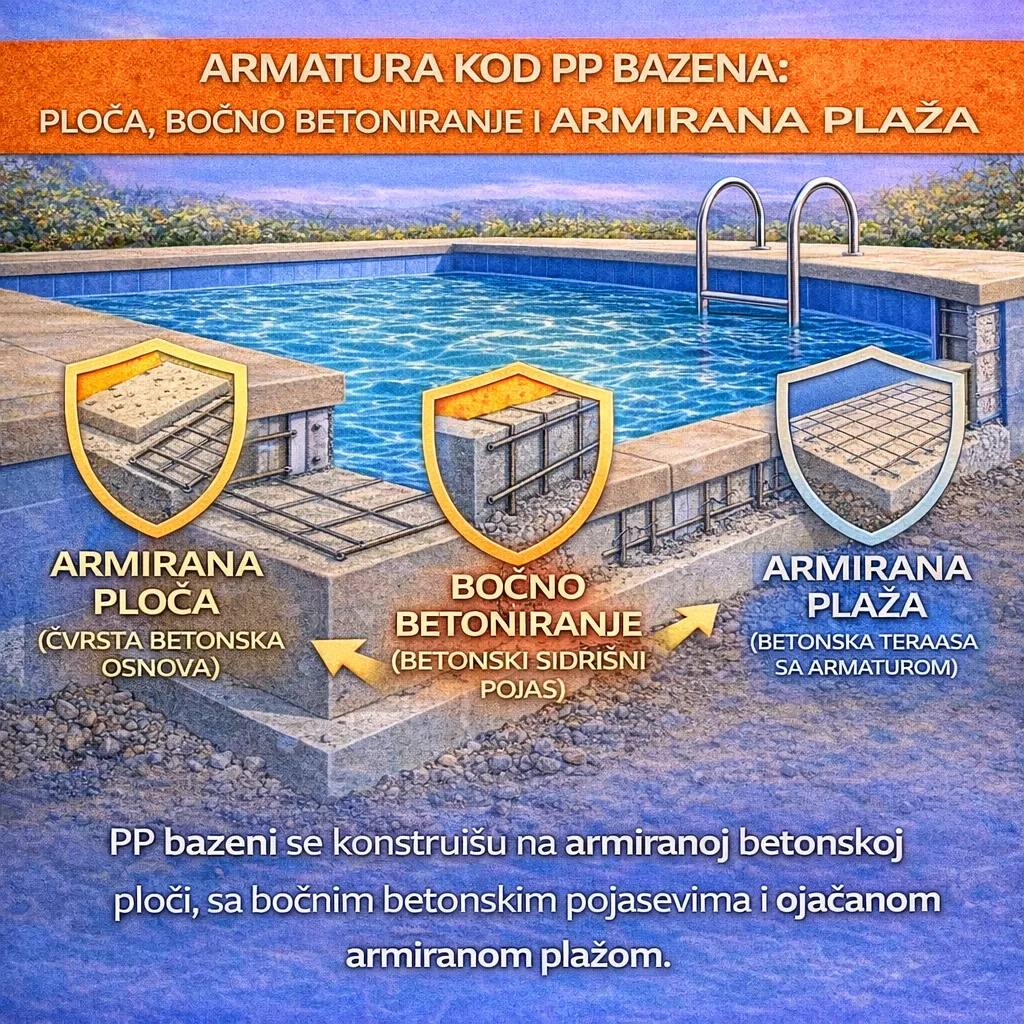
In polypropylene (PP) pools, reinforcement does not "strengthen the plastic" – it strengthens the concrete elements that support and stabilise the entire system: the base slab beneath the pool, the side zones alongside the walls, and the concrete deck surrounding the pool.
Why is reinforcement critical in PP pools?
A PP pool is a self-supporting shell, but it must not rest directly on the ground or absorb soil loads. Stability is achieved through a properly executed concrete base and lateral backfilling, while reinforcement ensures that the concrete acts as a true structure: stable, controlled, and free from cracks that cause problems later.
1) Reinforcement mesh in the concrete base slab
The concrete base slab is the structural foundation. Its tasks are to distribute loads evenly (water + pool), prevent differential settlement, and provide a perfectly level surface.
How the slab is reinforced (principle)
- Top and bottom reinforcement zones (double mesh) – because the slab works in bending.
- Concrete cover provided by spacers (to prevent the mesh from lying flat on the substrate).
- Mesh overlaps and tying according to the rules (so the slab behaves monolithically).
- Dimensioning (slab thickness and mesh type) based on the structural calculation and site conditions.
2) Reinforcement alongside the pool walls (lateral backfilling)
After the pool is set in place, the space between the excavation walls and the pool walls is filled with concrete in layers. The purpose of this concrete is to stabilise the walls, absorb lateral soil loads, and prevent shell deformation.
How the lateral zone is reinforced (principle)
- A reinforced cage is formed alongside the pool wall (vertical and horizontal bars or mesh – depending on the design solution).
- The reinforcement is placed so that the concrete acts as a stabilising envelope – it is not connected to the PP pool shell.
- Concreting proceeds in layers while the pool is simultaneously filled with water to equalise pressures on both sides.
3) Deck (pool surround) reinforcement
The deck around the pool is a structural element subject to loads from people, sun loungers, furniture, and thermal expansion. If done incorrectly, it can transfer stresses to the pool shell, crack, or lift at the edges.
Deck reinforcement rules (principle)
- The concrete deck slab is reinforced with mesh or bars according to the project design.
- An expansion joint between the deck and the pool is mandatory – there must be no rigid "lock" between them.
- The expansion gap is solved with an elastic sealant or profile, allowing the deck to move independently.
- Deck falls are formed away from the pool toward the drain – so that water does not flow into the joint between the pool and the deck.
Most common mistakes
- Thin or poorly reinforced base slab beneath the pool.
- Reinforcement or concrete bearing against the PP wall (rigid connection, load transfer to the shell).
- Concreting without water in the pool (risk of deformation from unbalanced pressure).
- Deck without an expansion joint (cracking, stress transfer to the pool).
- Lack of level and slope control (water flows into the joint, causing freeze-thaw damage).
Conclusion
Reinforcement in a PP pool project is what turns "placing a shell" into a lasting solution. A well-reinforced base slab, correctly reinforced lateral backfilling, and a professionally reinforced deck with proper expansion joints – that is the recipe for a PP pool that performs stably, without deformation and without costly repairs.
Note: specific dimensions (slab thickness, mesh type, bar spacing, cover depths) must be aligned with the structural calculation, geotechnical conditions, and the project design.