
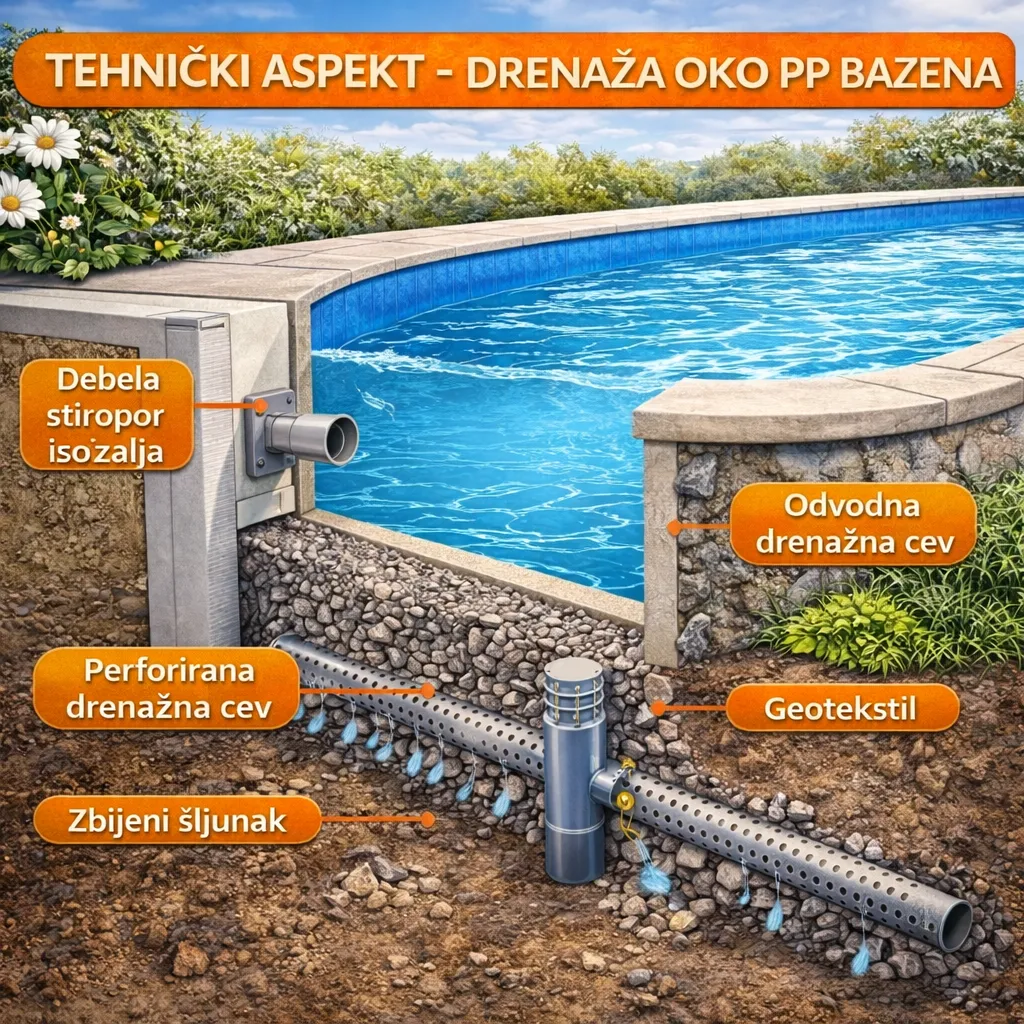
Drainage around a PP (polypropylene) pool is one of the most important, and often most underestimated, elements of pool installation. Its role is to control groundwater and surface water around the pool and prevent the build-up of external pressures that could compromise the stability of the entire structure.
Why water around the pool is a problem
When water accumulates in the soil around the pool, hydrostatic pressure acts on the walls and base of the pool from the outside. This pressure is particularly dangerous when the pool is empty or only partially drained.
Most common problems without drainage
deformation of the pool walls,
stress on welds and reinforcements,
uplift of the pool floor (buoyancy),
persistent moisture around the structure and equipment.
What a proper drainage system looks like
A correctly executed drainage system includes drainage pipes around the pool, a layer of drainage gravel, and a mandatory inspection and collection sump from which water can be pumped away as required.
When drainage is mandatory
on sites with a high groundwater table,
in clay-rich and poorly permeable soils,
for larger and deeper pools,
in areas with heavy rainfall.
Most common mistakes
omitting drainage entirely,
laying pipes without the correct fall,
absence of a collection sump,
mixing the drainage layer with soil without geotextile membrane.
Conclusion
Drainage is not an optional extra — it is a safety-critical element. A properly designed drainage system protects a PP pool from external pressures, extends the life of the structure, and prevents costly and complex problems in the future.