
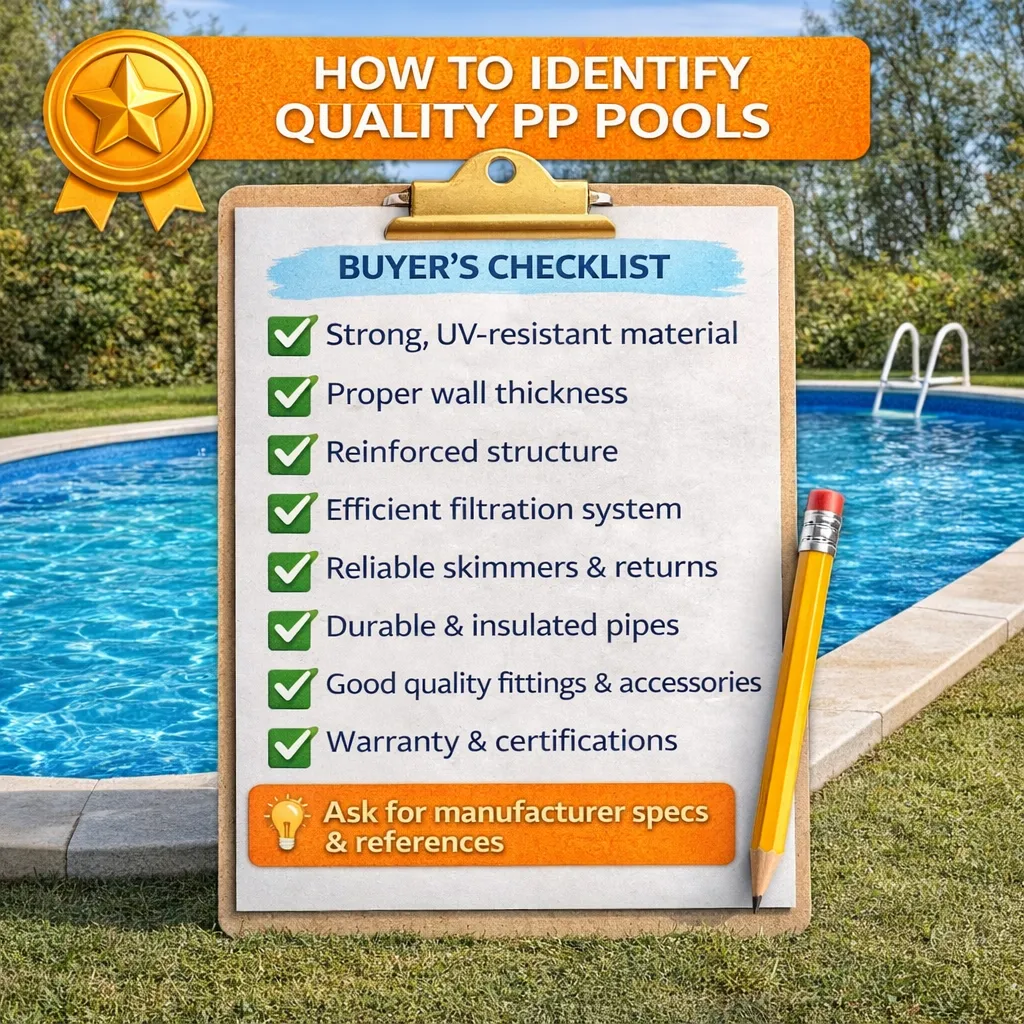
Purchasing a PP (polypropylene) pool is a significant investment, and differences in quality are often not visible at first glance. Two pools may look similar in photographs, but in practice differ considerably in stability, longevity, maintenance requirements, and reliability. This checklist helps the buyer ask the right questions and recognise the quality of construction and installation.
1) Material: grade and UV stabilisation
whether PP-R (or the appropriate pool grade) is used,
whether the sheets are UV-stabilised (particularly in the zone above the waterline),
whether the manufacturer can provide the origin and specification of the sheets.
2) Sheet thickness and structural concept
what thickness is used for walls and floor (6/8/10 mm and where each is applied),
whether there is a logical rationale: larger/deeper pool → more substantial construction,
whether a proper structural concept is applied, not just guesswork.
3) Reinforcements and ribs
rib spacing and dimensions appropriate to the pool depth,
quality of the rib-to-shell connection (structural weld),
whether additional reinforcement is provided at critical zones (corners, overflow, wide walls).
4) Welds: aesthetics and strength
uniform, clean weld without pores or burn marks,
external structural welds (not just internal cosmetic finishing),
whether manual and extrusion welding are combined where appropriate.
5) Fittings and compatibility
quality of skimmers, inlet nozzles, floor drains, and lights,
whether seals and installation are carried out professionally,
whether pipework is properly supported (pipes must not place stress on fittings).
6) Hydraulics and circulation
logical placement of skimmers and return inlets,
avoidance of dead zones (corners, steps, benches),
correctly sized pump and filter for the pool volume.
7) Installation: base slab, drainage, backfilling
concrete base slab and correct substrate preparation,
drainage (especially where groundwater risk is present),
backfilling in layers whilst simultaneously filling with water.
8) Insulation and energy logic
insulation of floor and sides (extruded polystyrene or agreed solution),
thermal cover as part of the package or a clear recommendation,
realistic heating recommendation based on season and budget.
9) Documentation, warranty, and references
clear warranty terms (what is covered by the shell, what by the equipment),
reference projects and genuine photographs,
maintenance and servicing instructions.
10) The most important question: who stands behind the pool?
Pool quality is the sum of materials, technology, and installation. The most reliable indicator is a team with experience, standards, established procedures, and willingness to explain every detail — without any vagueness.
Conclusion
The best PP pool is not necessarily the cheapest, but the one that is correctly designed and professionally executed. Use this checklist to ask the right questions: material, welds, ribs, hydraulics, and installation. When everything is clear and transparent, the risk of problems is minimal and the pool will last for many years.