
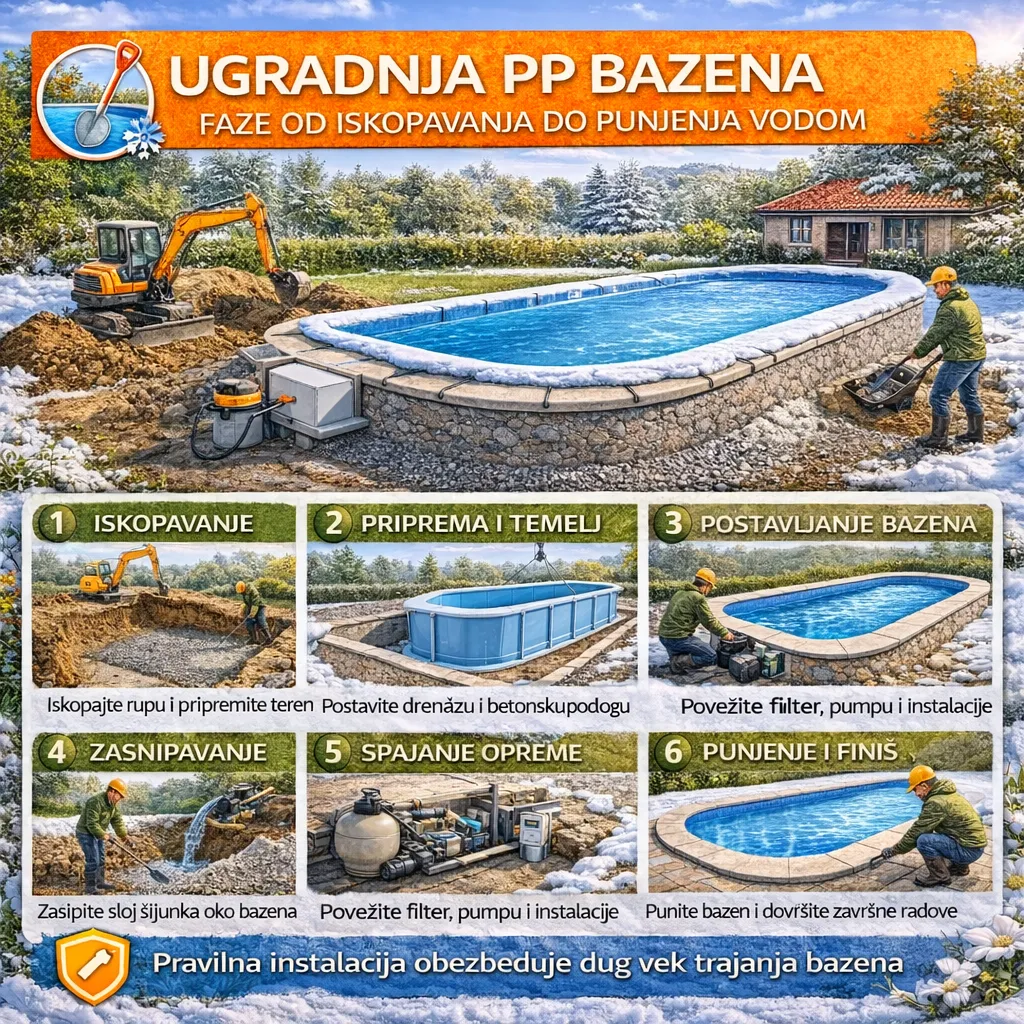
Installing a PP (polypropylene) pool is a technical process that takes place in clearly defined phases. When each phase is carried out correctly and in the right sequence, the result is a stable, long-lasting, and safe pool with no subsequent problems.
1) Site excavation
Excavation is carried out to the precise dimensions of the pool, with additional space for working access, drainage, and insulation. The pit walls must be stable, and the base must be level and well compacted.
2) Drainage and base preparation
On sites where groundwater may be present, a drainage layer (crushed stone and drainage pipe) is installed. This prevents the pool shell from being lifted and prevents water pressure building up beneath it.
3) Concrete base slab
A reinforced concrete slab of the appropriate thickness is constructed — perfectly level and true. The slab forms the foundation for the structural stability of the PP pool.
4) Lowering the pool into the pit
The pool is lowered by crane or lorry-mounted crane, using protective strapping. Positioning must be precise, with no resting against the pit walls.
5) Levelling, connecting buried pipework and initial filling
Once positioned, the pool is levelled. All pipes that will be buried (skimmers, return jets, suction lines) are connected and tested for leaks while they are still accessible. Gradual filling with water then begins, so that the shell is stabilised before backfilling commences.
6) Lateral backfilling
Backfilling is carried out in layers (most commonly concrete or a sand-cement mix), synchronised with filling the pool with water, so that pressures on both sides are equalised.
7) Connecting the equipment in the technical room
The pump, filter, heating and automation are connected to the already laid and tested pipework in accordance with the project design. All connections are checked again before works are completed.
8) Final filling and commissioning
The pool is filled to its operating level, the system is commissioned, and the correct operation of the circulation, filtration, and watertightness is verified.
Most common mistakes
incorrectly constructed concrete base slab,
omitting drainage where it is required,
backfilling without simultaneous water filling.
Conclusion
PP pool installation must be viewed as an integrated whole. Correctly executed phases from excavation to filling guarantee a long service life, structural stability, and carefree pool use.