
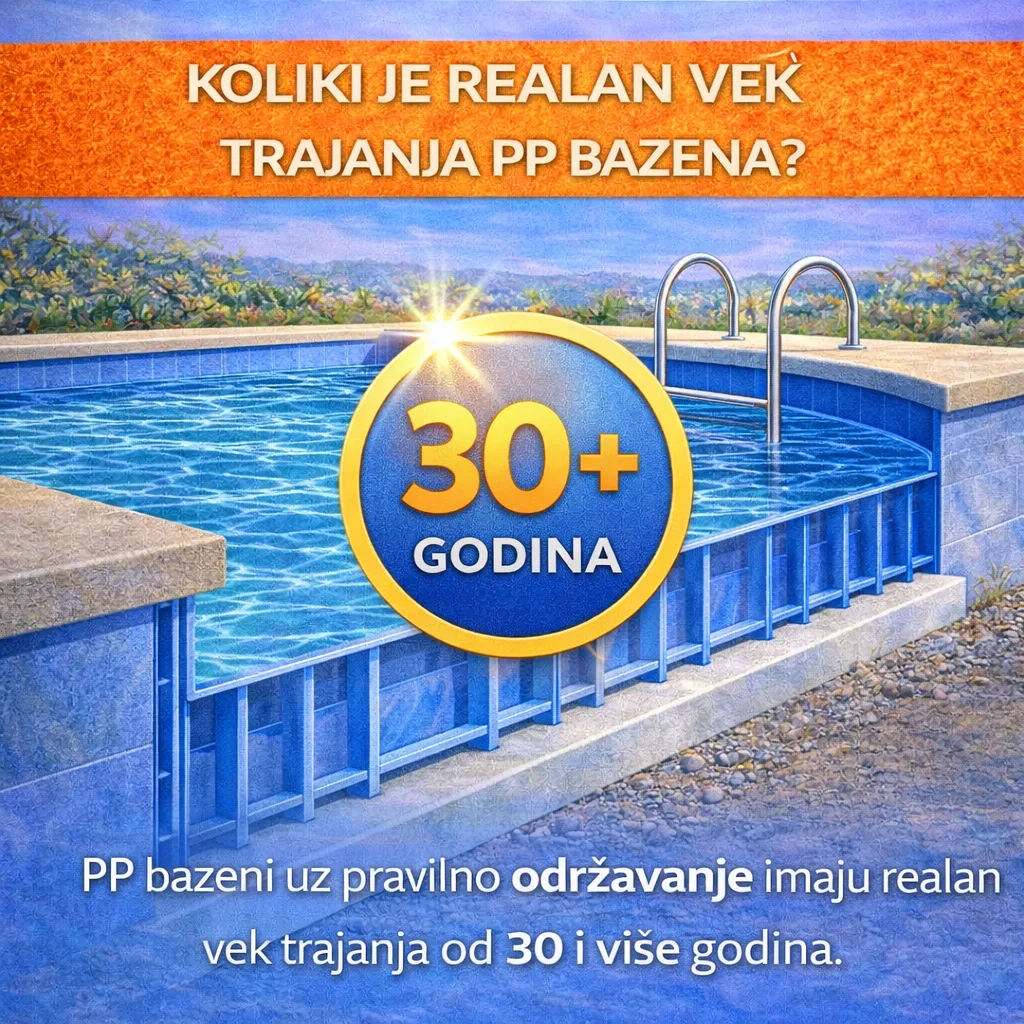
The realistic lifespan of a PP (polypropylene) pool is not a single fixed number, because it depends on sheet quality, fabrication quality (especially welds), structural design (reinforcements), installation, and how the pool is used and maintained. However, when a PP pool is made from high-quality material, properly engineered, and professionally installed, it is realistic to expect a long service life from the shell – with stable performance and without “major renovations” of the shell itself.
It is important to separate two things: the lifespan of the shell and the lifespan of the equipment. Equipment (pump, filter, heating, automation) is consumable and will be serviced or replaced over time, while the shell should be the long-term foundation of the system.
What do we mean by “lifespan”?
When we talk about the lifespan of a PP pool, we usually mean that the shell remains:
watertight (no leakage through the structure),
structurally stable (no wall or floor deformation),
visually sound (no serious surface damage),
functional (no issues at joints or built-in components).
Normal signs of use can appear over time, but that is not the same as a structural failure.
What most affects the longevity of a PP pool?
PP material quality
The quality of polypropylene sheets is the base of everything. Consistency, appropriate thickness for the design, and UV stabilization (especially in sun-exposed areas) matter. Low-quality material can age faster, become more brittle, or respond poorly to outdoor conditions.
Weld quality (the most critical point)
Welds are the “heart” of a PP pool. They are both the mechanical bond and the watertight seal. High-quality welds are continuous, without pores or breaks, without overheating the material, and done with correct technique (temperature, speed, pressure, tools, and quality welding material). In practice, the most common long-term issues on the market come from poor welding or weak quality control.
Structural design and reinforcements
A PP pool must be structurally supported by properly engineered reinforcements (ribs) and a sensible structural concept. Walls must resist the loads from water and surrounding soil. Under-designed reinforcements or weak details can lead to deformation over time – especially if installation is also done incorrectly.
Installation: base, drainage, insulation, backfilling
Even a perfect shell can fail if installation is wrong. The base must be stable and accurately leveled, drainage must manage groundwater and moisture, insulation improves comfort and reduces heat loss, and backfilling must be done correctly – typically in layers, while filling the pool with water to balance pressure. These are not small details; they are key to long-term stability.
Water balance and chemistry
PP handles standard pool chemistry well, but extremes (long-term very low or very high pH, overly aggressive disinfection, uncontrolled dosing) can accelerate surface aging and cause aesthetic changes. Stable water parameters protect both the shell and the equipment.
Real-world expectations: shell vs equipment
In real life, in a properly executed PP pool, equipment is the part that is serviced or replaced most often, while the shell remains the foundation. Over the years, owners typically invest in “system upgrades” (pump, filter, automation) rather than “pool reconstruction” of the shell.
Shell: long-term foundation with minimal interventions when built properly.
Equipment: consumable components serviced and replaced in cycles.
How to recognize a PP pool built to last
clearly defined sheet thickness and a coherent structural concept,
consistent, clean welds (inside and outside),
proper reinforcements and strong detailing at critical areas (corners, transitions, steps),
professional installation: base, drainage, insulation, correct backfilling,
properly sized equipment and correctly positioned components (skimmer, returns, lighting).
Conclusion
The realistic lifespan of a PP pool is long when it is executed professionally: quality material, excellent welds, correct structural design, and correct installation. In that case, the shell remains the long-term foundation, while equipment is serviced and replaced over time. The biggest enemy of longevity is not “PP as a material,” but poor fabrication and poor installation. When those are done right, a PP pool can remain stable, attractive, and functional for many years without major shell interventions.