
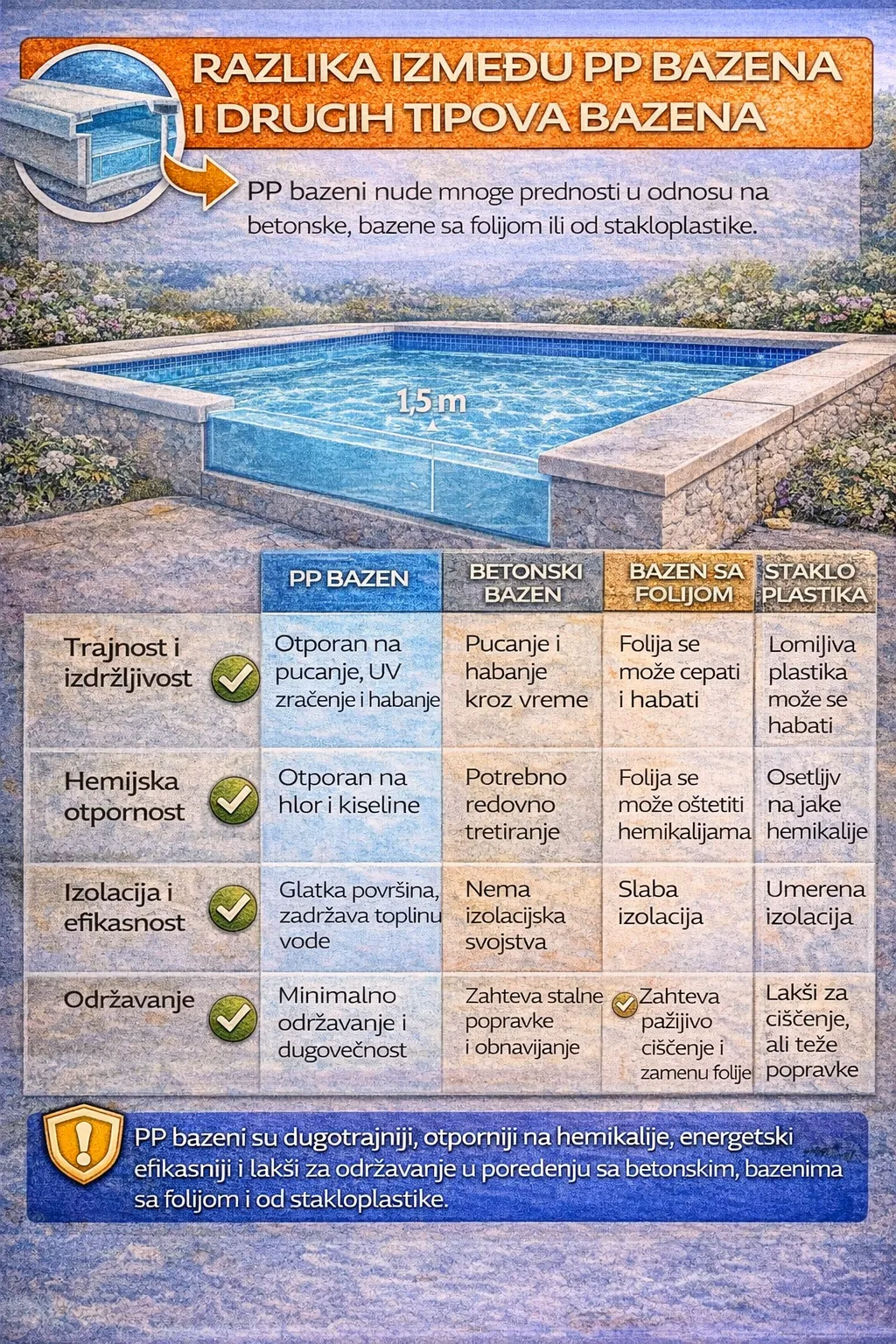
When people say “a swimming pool,” it can sound like a single product – a hole in the ground filled with water. In real life, the differences between pool systems are huge, and they usually show up after the first, second, and third season: in structural stability, maintenance effort, long-term costs, and whether the pool runs smoothly or constantly needs fixes. A PP (polypropylene) pool is specific because the pool shell is both the structure and the finished, watertight surface. With many other pool types, waterproofing is achieved through additional layers, finishes, or coatings.
Below are the key differences that directly affect quality, timelines, and long-term reliability. The goal is not to attack any system, but to explain what you’re actually buying and why PP is often a strong choice for residential projects.
1) Structure and waterproofing
PP pool: a welded, one-piece shell – the material is both the structure and the finished watertight surface. No extra liner, tiles, or coatings are required for waterproofing.
Other systems: waterproofing is often achieved via additional layers (e.g., liners, tile systems plus waterproof membranes, or coatings). That creates more interfaces where problems can occur: base, membrane, adhesive, grout joints, and the final finish.
2) Installation speed and predictability
PP pool: the shell is manufactured in advance to the project’s dimensions, so on-site work focuses on preparation and installation. This typically means shorter timelines and fewer surprises.
Other systems: often involve more phases and “wet works” (multiple layers, curing times, weather dependency). Timelines can vary more.
3) Surface and maintenance
PP pool: the smooth surface is practical and comfortable. Dirt tends to adhere less, and cleaning is simpler when circulation and water chemistry are properly managed.
Other systems: surfaces with grout lines, more porous finishes, or sensitive coatings can require more detailed cleaning, especially at joints and transitions.
4) Typical long-term risks
PP pool: the critical points are weld quality, properly engineered reinforcements, and professional installation (base, drainage, insulation, correct backfilling). When executed correctly, the system is stable and predictable.
Other systems: issues often occur at interfaces where materials “move” differently: finishes, waterproof layers, grout, adhesives, and coatings. Over time you can see leaks at joints, debonding, cracking grout, or surface degradation.
5) Aesthetics and design
PP pool: delivers a clean, modern look and makes it easy to integrate steps, benches, shallow zones, and other made-to-measure features. The design is built as one unified shell.
Other systems: can offer specific aesthetic options through finishes and materials, but they often require more complex execution and more phases to achieve a flawless final look.
6) Energy efficiency and insulation
PP pool: works very well with insulation systems. When the bottom and sides are properly insulated, heat loss is reduced, comfort increases, and heating becomes more efficient.
Other systems: energy efficiency depends on the overall structure and insulation, but multi-layer systems often have more potential weak spots (thermal bridges, installation imperfections) that reduce performance.
7) Service and repairs
PP pool: most service needs relate to equipment (pump, filter, heating, automation) – just like any pool. The shell itself, when properly made and installed, typically does not require frequent interventions.
Other systems: beyond equipment, there can be long-term repairs related to the finish: grout, coatings, membranes, or surface restoration, which can be more expensive and more disruptive.
What’s the core difference?
In simple terms: a PP pool is “one material – one watertight shell – one finished surface.” Many other systems rely on multiple layers working perfectly together for years. The more layers you have, the more interfaces exist where a small mistake or weak detail can become a future problem.
Conclusion
A PP pool is a modern residential choice because it combines faster installation, clean aesthetics, practical maintenance, and long-term stability – provided fabrication and installation are professional. When comparing pool systems, don’t look only at the initial price; look at what the finished watertight surface is, how many phases the system requires, how sensitive it is to details, and what the realistic long-term costs look like over several seasons.