
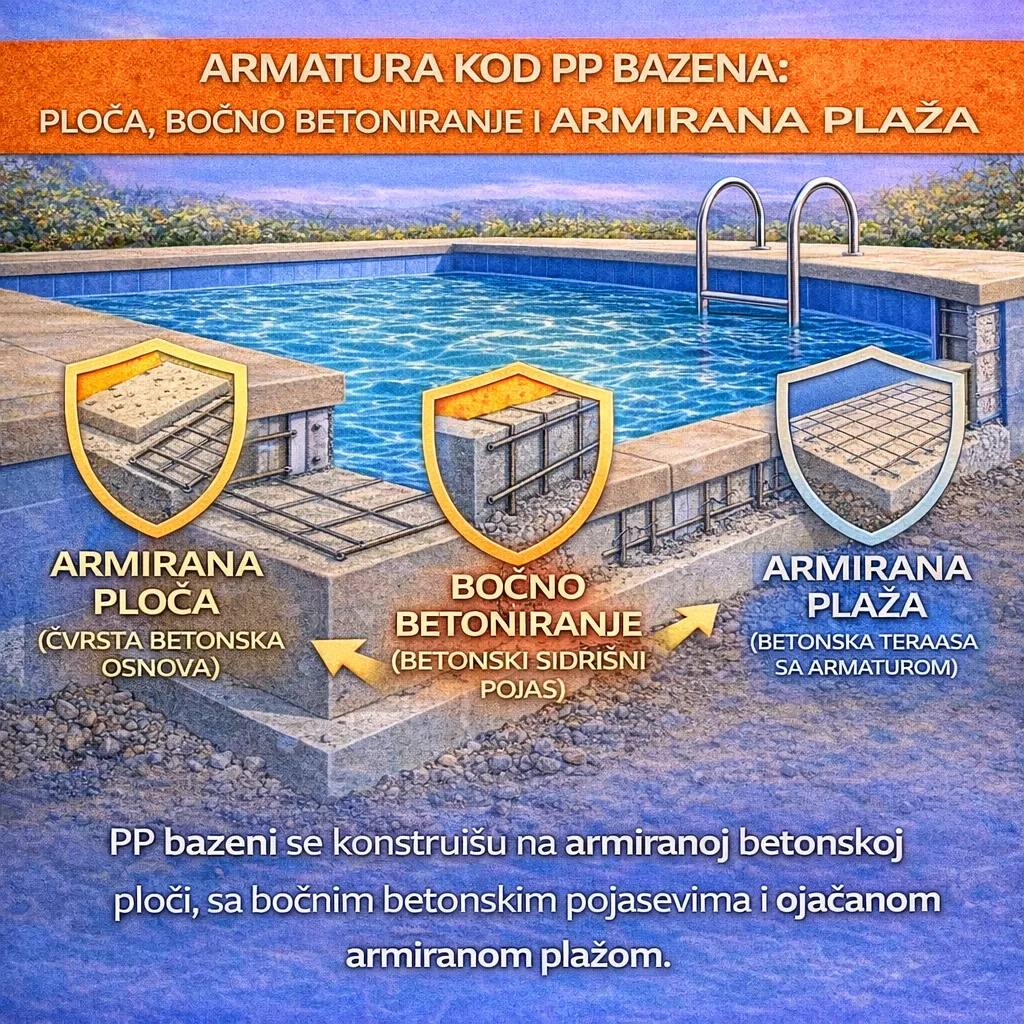
Reinforcements and ribs are among the most important structural elements of a PP (polypropylene) pool. Their role is to provide the static stability of the shell and prevent wall deformation under water pressure from inside and soil pressure from outside. In PP pools, sheet thickness matters, but without correctly designed ribs, even the best material cannot guarantee long-term stability.
Why are ribs necessary?
PP is a thermoplastic with a degree of inherent flexibility. Under heavy loads (water column height, soil pressure, temperature changes), pool walls can "work" if they are not adequately stiffened. Ribs distribute the load and hold the walls in their correct geometry, preventing buckling and permanent deformation.
What loads do ribs carry?
water pressure (particularly in deeper pools),
soil and backfill pressure,
local loads from the surroundings and the pool deck construction,
thermal expansion and contraction.
What do ribs look like in PP pools?
Ribs are vertical or combined stiffeners located on the exterior of the pool walls. They are most commonly in the form of profiles or sheets welded to the wall, and may also be constructed as "box" reinforcements, depending on the design.
Rib spacing and sizing
Rib spacing is not arbitrary. It depends on:
pool depth,
wall sheet thickness,
wall length and overall pool dimensions,
type of backfill material and soil conditions,
the design of the deck and surrounding area.
The deeper and larger the pool, the more substantial and correctly spaced the ribs must be.
The connection between ribs and walls
The rib must be properly welded to the pool wall using a structural weld capable of carrying the load. A poor weld or poorly executed connection reduces the rib to mere decoration rather than a functional reinforcement.
Ribs and correct installation
Even perfect ribs cannot compensate for poor installation. Correct backfilling in layers whilst simultaneously filling the pool with water is essential, as this balances the pressures on both sides and prevents wall deformation during assembly.
Most common reinforcement mistakes
too few ribs or excessive rib spacing,
rib dimensions insufficient for the pool depth,
poor structural welds between ribs and walls,
ignoring groundwater and drainage,
incorrect backfilling without simultaneous water filling.
Conclusion
Reinforcements and ribs are the "skeleton" of a PP pool. Correctly designed and executed ribs, combined with quality welds and professional installation, ensure that a PP pool remains stable, straight, and long-lasting. Ribs are therefore not an area to cut costs, but a key indicator of quality.