
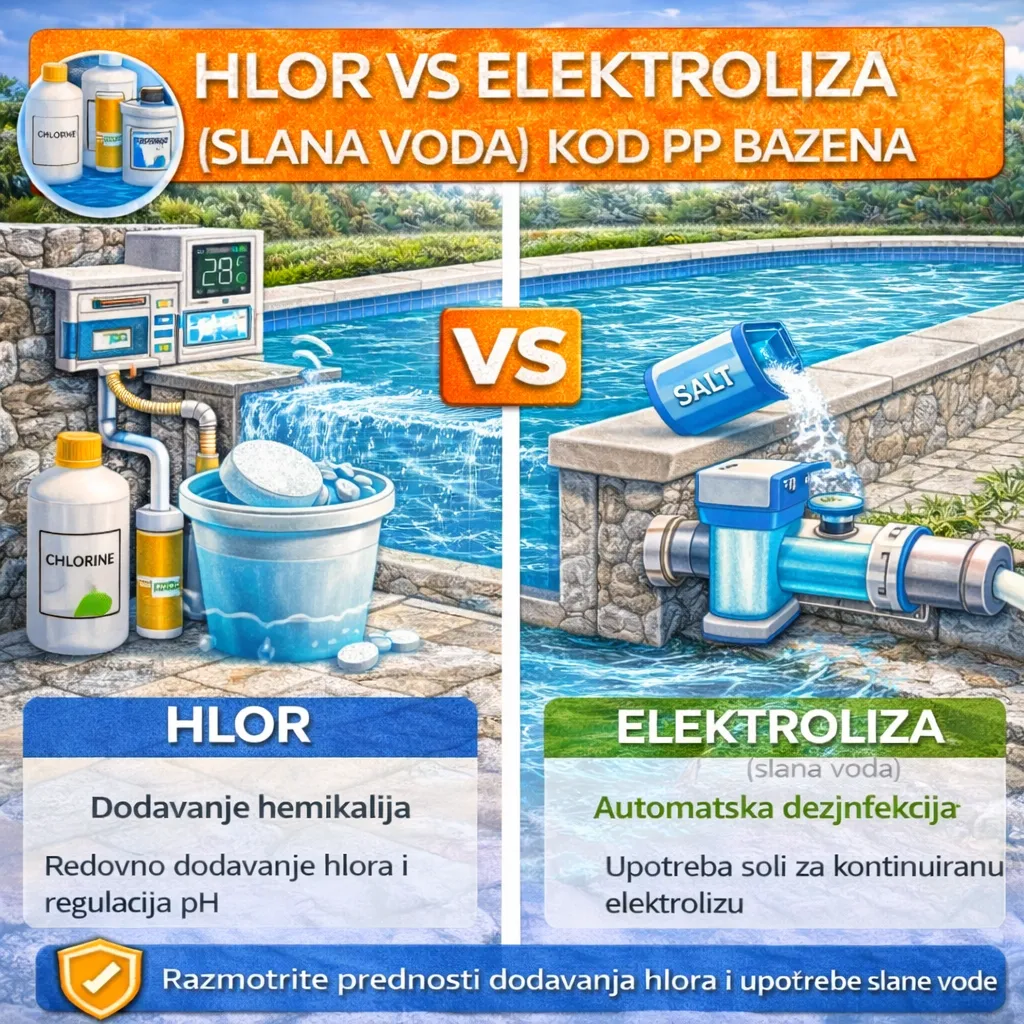
In PP (polypropylene) pools, water disinfection is most commonly achieved in one of two ways: conventional chlorination or salt electrolysis (so-called "saltwater"). Both methods are effective, but they differ in terms of comfort, automation, costs, and maintenance. The good news is that PP is an excellent base material for both systems, as it is chemically stable and does not corrode.
What is conventional chlorination?
Chlorination involves adding chlorine to the pool water in the form of tablets, granules, or liquid. Chlorine destroys bacteria and algae and provides residual protection in the water. It can be dosed manually or automatically via a dosing pump.
Advantages of chlorine
reliable and proven disinfection system,
rapid action and good water control,
lower initial equipment cost (no electrolytic cell required),
straightforward shock treatment when needed.
Disadvantages of chlorine
more manual work when no automation is in place,
possible odour and irritation if pH is not balanced,
requirement for regular monitoring and dosing.
What is salt electrolysis?
Salt electrolysis uses a device (electrolytic cell) that generates chlorine from dissolved salt in the water. The water is not "seawater" but only mildly saline. The system generally operates automatically and maintains a more stable level of disinfection throughout the season.
Advantages of salt electrolysis (saltwater systems)
greater comfort and less manual dosing,
more stable disinfection regime,
a softer water feel preferred by many users,
PP pools are well suited as PP does not corrode.
Disadvantages of salt electrolysis
higher initial cost (equipment and installation),
need to monitor salt levels and maintain the cell,
pH still needs to be controlled in practice (it tends to rise),
sensitivity to an undersized system (a weak cell for a large pool).
Which is better for a PP pool?
There is no universally "better" option for everyone — only the better choice for your habits. If you want simplicity and a lower upfront cost, conventional chlorine is an excellent option, particularly when paired with a dosing pump. If you want maximum comfort and automation, salt electrolysis is often the best choice, especially when it is correctly sized.
The key common to both systems: pH and filtration
Regardless of which system you choose, pH must remain stable (ideally 7.2–7.6) and filtration must run for sufficient time. Most problems attributed to "chlorine" or "saltwater" are actually caused by poor pH balance, inadequate filtration, or incorrect dosing.
Conclusion
Both chlorine and salt electrolysis are excellent options for PP pools. Chlorine is simpler and less expensive to start with, whilst salt electrolysis brings greater comfort and automation. The most important factor is that the system is correctly sized and that water quality is maintained consistently through pH control, filtration, and regular monitoring.