
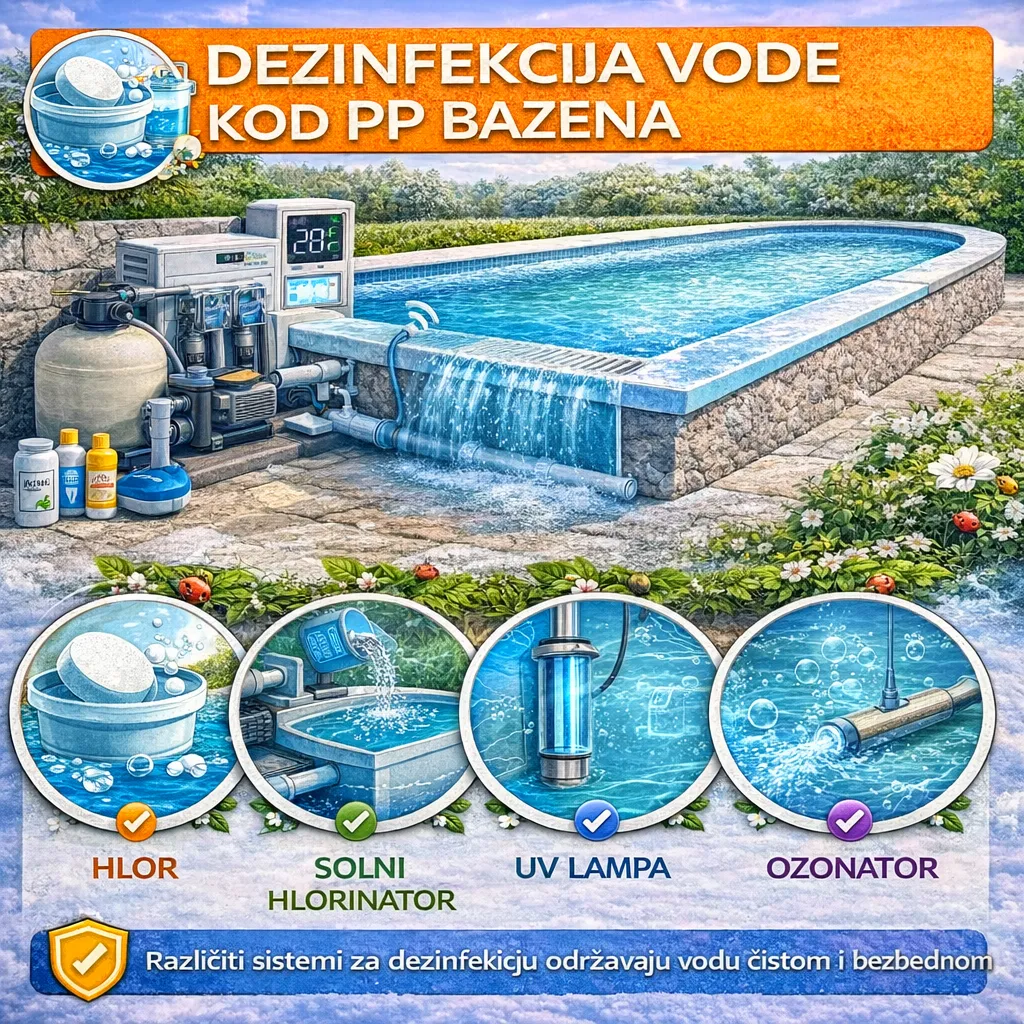
Water disinfection is an essential part of maintaining every PP (polypropylene) pool. Filtration removes mechanical impurities, but without disinfection the water cannot remain hygienically safe, as microorganisms (bacteria, algae, fungi) constantly develop within it. The goal of disinfection is straightforward: stable, clear, and safe water for swimming.
Why is disinfection mandatory?
During pool use, organic loads enter the water: sweat, cosmetics, dust, insects, and pollen, as well as microorganisms. Without disinfection, water can rapidly become cloudy, develop an odour, and become a health hazard. Even when a pool "looks clean", a microbiological risk may still be present.
PP material and disinfection
PP is chemically stable and tolerates standard disinfection systems well, provided the water is maintained within the recommended parameters. The smooth PP surface offers an additional benefit, as contaminants adhere less readily, making the system easier to keep in balance.
The most common disinfection systems
1) Chlorine (classic disinfection)
Chlorine is the most common and most effective disinfection system for private and public pools. Its advantages are reliability and rapid action. It can be dosed manually (tablets/granules) or automatically (dosing pump).
Advantages: powerful disinfection, stable system, readily available.
Important: pH must be in balance for chlorine to work effectively.
2) Salt electrolysis (saltwater)
Salt electrolysis produces chlorine from dissolved salt in the water. The user benefits from the comfort of "saltwater", and disinfection is stable and automatic when the system is correctly calibrated. PP pools are well suited to electrolysis because PP does not corrode and tolerates this regime well.
Advantages: stable dosing, less manual work, pleasant feel of the water.
Important: pH, other water parameters, and salt level must still be monitored.
3) UV disinfection (supplementary system)
UV lamps destroy microorganisms as water passes through a UV chamber. UV is generally used as a supplement, as it does not provide "residual" protection within the pool itself. For this reason, it is often combined with a reduced quantity of chlorine or another system.
4) Active oxygen and alternative systems
Active oxygen is used as an alternative to chlorine, but in practice it often requires additional corrections and careful management, particularly under heavier bather loads. It can be a good choice for specific needs, but is most commonly used alongside additional control measures.
The most important water parameters (the foundation of disinfection)
pH value: critical for disinfection effectiveness and swimmer comfort.
Disinfectant: stable level of free chlorine or equivalent.
Circulation and filtration: without adequate flow, disinfection cannot work evenly.
Most common disinfection mistakes
neglecting the pH value,
insufficient filtration run time and poor circulation,
excessive shock treatment without justification,
dosing chemicals directly onto the PP surface without dilution.
Conclusion
Water disinfection is mandatory for every PP pool and forms the cornerstone of hygiene and safety. PP material tolerates standard systems (chlorine, electrolysis) very well, and with correctly balanced water parameters and good circulation, maintenance can be straightforward and predictable. The most important factors are maintaining a stable pH, adequate filtration, and a consistent disinfection regime.