
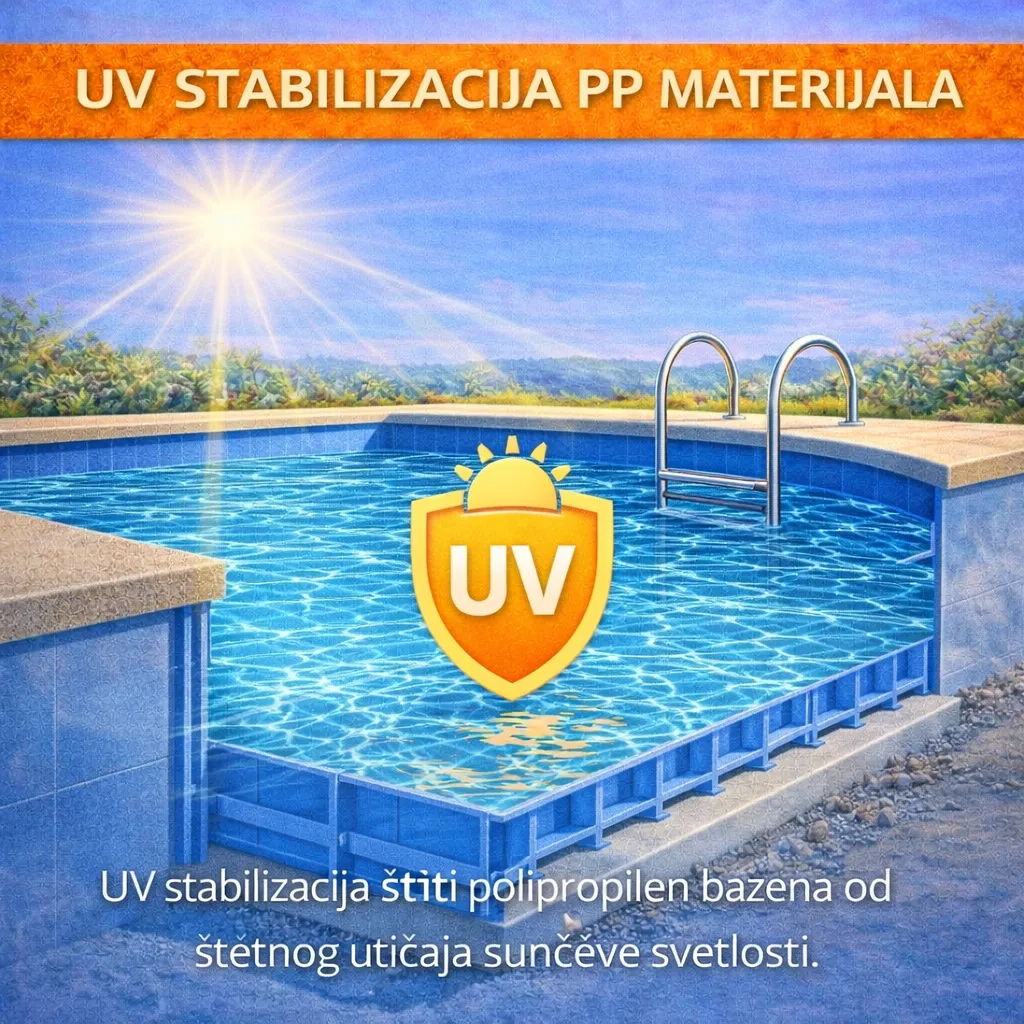
UV stabilisation of polypropylene (PP) is one of the key factors in the longevity and reliability of PP pools. Although PP is highly resistant to moisture and chemicals, without adequate UV protection the material can degrade over time under the influence of solar radiation, particularly in areas above the waterline.
What is UV radiation and how does it affect PP?
Ultraviolet (UV) radiation from sunlight gradually breaks down polymers. In unstabilised PP material, this can lead to:
colour loss and fading,
surface hardening and brittleness,
micro-cracking on the surface,
reduction in mechanical strength.
How does UV stabilisation work?
UV stabilisation is achieved by incorporating special additives into the PP material itself during the manufacture of the sheets. These additives absorb or neutralise UV radiation, preventing it from breaking down the polymer structure.
It is important to note that UV stabilisation is not a coating or surface layer — it is an intrinsic part of the material throughout the entire thickness of the sheet.
Why is UV stabilisation particularly important for pools?
In PP pools, the upper sections of the walls, the edges, and the overflow areas are constantly exposed to sunlight. Without UV stabilisation, these are precisely the parts that first show signs of ageing. UV-stabilised PP retains its colour, flexibility, and surface quality for many years.
Is every PP material UV-stabilised?
No. There are PP sheets designed for indoor or industrial applications that do not contain UV additives. Using such material for pools can lead to accelerated deterioration, even if the welds and structure have been correctly executed.
How to identify quality UV-stabilised PP?
clear manufacturer specification confirming UV stabilisation,
material designated for outdoor use,
uniform colour throughout the entire thickness of the sheet,
compatible UV-stabilised welding rods.
Impact of UV stabilisation on pool service life
PP pools made from UV-stabilised material have a significantly longer service life, a more stable surface, and a reduced need for interventions over the years. UV stabilisation directly determines whether a pool looks and performs as well after many years as it did at the outset.
Conclusion
UV stabilisation of PP material is not an added luxury — it is a fundamental requirement for a quality PP pool. Without it, even a well-constructed pool can gradually lose its properties. For this reason, the selection of UV-stabilised PP material is one of the key criteria in building a durable and reliable PP pool.