
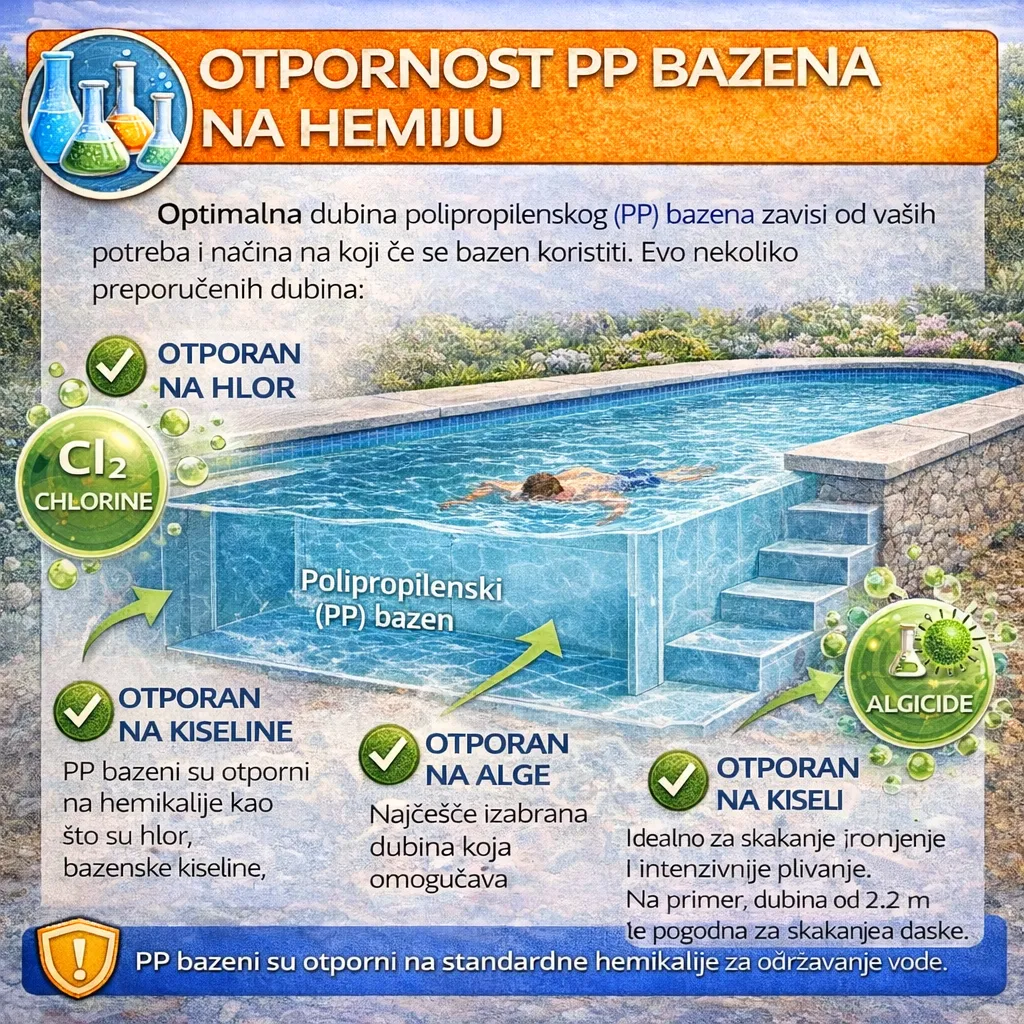
One of the greatest advantages of PP (polypropylene) pools is their exceptional resistance to pool chemicals. PP material is chemically stable, does not react with the majority of substances used for disinfection and water balancing, and is therefore highly suitable for long-term use in pool environments.
What chemicals are used in pools?
In a standard pool maintenance regime, various chemical substances are used, the most common of which are:
chlorine (in various forms),
salt electrolysis (saltwater),
pH regulators (pH minus and pH plus),
algaecides,
flocculants and stabilisers.
How does PP react to pool chemicals?
PP is an inert material in contact with water and standard pool chemistry. This means that no chemical reaction occurs that would damage the structure or surface of the pool. The surface remains smooth, free from corrosion, rust, or flaking — problems that are common with certain other pool types.
Resistance to chlorine
PP tolerates chlorine very well at the concentrations used in private and public pools. Correctly dosed disinfection does not affect the colour, strength, or welds of a PP pool. Problems may arise only in cases of extremely incorrect dosing or direct contact of concentrated chemicals with the surface without dilution.
PP pools and salt electrolysis
PP pools are particularly well suited to salt electrolysis systems. Unlike metal or concrete components, PP does not corrode and does not react with saltwater. For this reason, PP pools are a frequent choice for users who want a stable and long-lasting saltwater system.
The influence of pH value on PP material
PP is stable across a wide pH range. However, prolonged maintenance of water outside the recommended limits (excessively acidic or excessively alkaline water) can negatively affect pool equipment and user comfort, even if the PP material itself remains undamaged.
Welds and chemical resistance
High-quality PP welds possess the same chemical resistance as the base material. When the panels and electrodes are compatible and correctly welded, the weld does not represent a weak point in terms of contact with pool chemicals.
What can negatively affect the PP surface?
pouring concentrated chemicals directly onto the dry surface,
prolonged extreme pH imbalance,
use of non-approved or industrial chemicals.
Conclusion
PP pools are exceptionally resistant to pool chemicals and are therefore among the most straightforward systems to maintain. With correct dosing and adherence to basic usage guidelines, PP material retains its properties for many years. The chemical resistance of PP pools is one of the key reasons why this pool type is regarded as a long-lasting and reliable solution.