
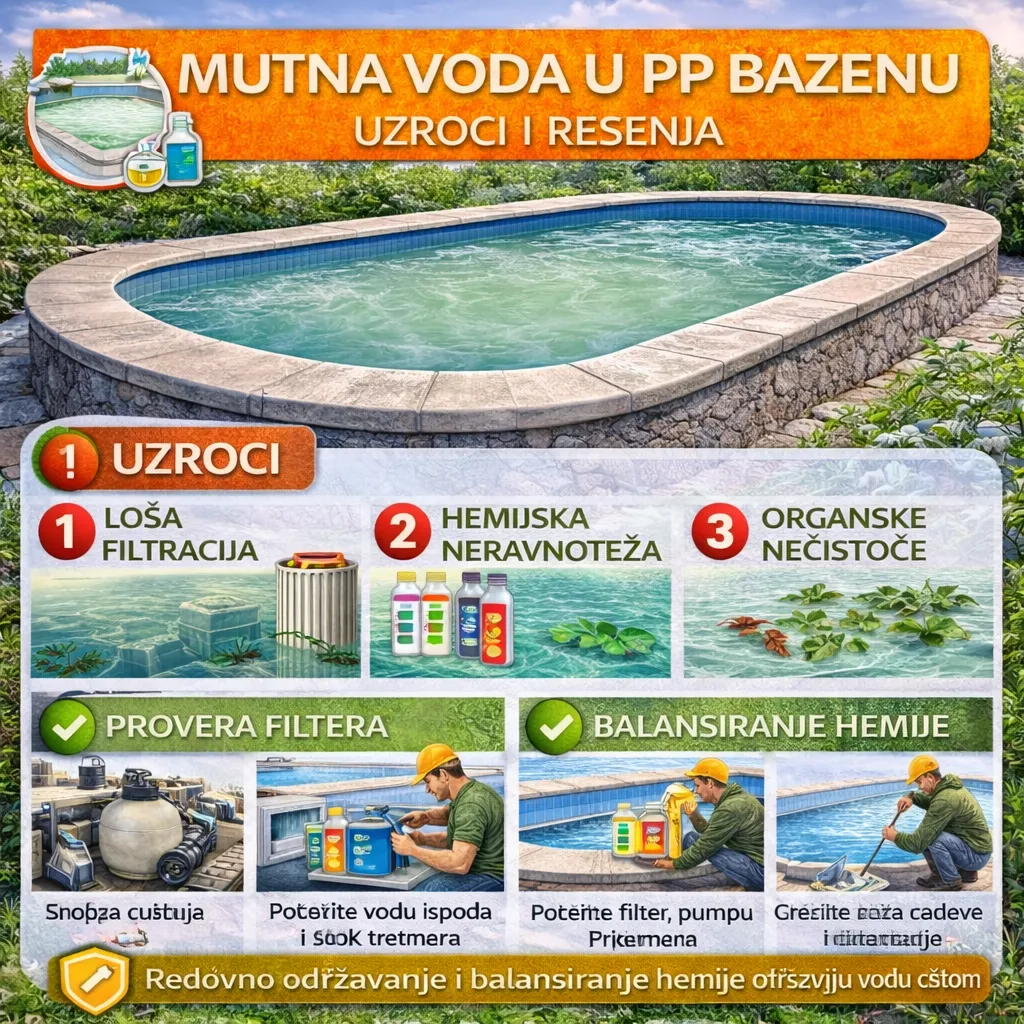
Cloudy water is one of the most common problems in pools, including PP (polypropylene) pools. The good news is that in most cases the cause is known and solvable: insufficient filtration, incorrect pH, inadequate disinfection, excessive organic load, or fine particles passing through the filter. It is important to address the problem systematically, step by step, rather than adding chemicals at random.
What does cloudy water look like?
Cloudiness may be mild (the water is not crystal clear) or pronounced (milky, grey, or greenish). The colour of the cloudiness often aids diagnosis: a greenish tint usually indicates the onset of algae, a milky appearance is often caused by fine particles or a pH/calcium imbalance, and grey cloudiness can result from a dirty filter and high organic load.
Most common causes of cloudy water
1) Insufficient filtration
If the pump and filter do not run for long enough, the water does not pass through the system a sufficient number of times per day. On hot days and under heavier bather loads, filtration must run longer. Weak flow (caused by a blocked pre-filter, dirty filter, or closed valves) makes the situation worse.
2) Dirty filter or incorrect filter media
A sand filter becomes clogged over time and loses efficiency. Without regular backwashing, cloudiness returns. If the media is old or incorrect, the filter cannot capture fine particles.
3) Incorrect pH
A pH outside the optimum range (7.2–7.6) reduces disinfection efficiency and can cause precipitation, a "milky" appearance, and a heavy feeling in the water. pH is often the hidden cause of problems.
4) Insufficient disinfection
When the chlorine level (or its electrolysis equivalent) is too low, microorganisms and algae begin to multiply. Cloudiness is often the first sign before the water turns green.
5) High organic load
Perspiration, cosmetics, pollen, dust, and a large number of bathers consume disinfectant and put strain on the filter. With intensive use, cloudiness is common without an enhanced filtration and disinfection regime.
6) Fine particles passing through the filter
Sometimes water is cloudy because the filter cannot capture very fine particles. In such cases, flocculation (where compatible with the filter type) helps to bind particles together into larger clusters that can then be removed by filtration.
Solution: a practical step-by-step plan
Step 1: Check flow and clean the pre-filter
Verify that the pump has good flow; clean the pump basket and skimmer baskets.
Step 2: Measure and correct pH
Bring pH into the range 7.2–7.6. Without this, disinfection and filtration will not achieve their full effect.
Step 3: Measure disinfection and apply shock treatment if necessary
If disinfection is low or algae are suspected, carry out a shock treatment and allow filtration to run for an extended period.
Step 4: Extend filtration run time
Filtration should run for longer until the water clears. In practice, "more filtration" is more effective than adding chemicals at random.
Step 5: Backwash and rinse the filter
Carry out a backwash and rinse cycle to flush dirt from the filter. If the filter is extremely dirty, repeat the process.
Step 6: Use flocculant if necessary
If cloudiness persists, use a flocculant compatible with the filter type. After flocculation, extended filtration and/or vacuuming up settled sediment gives the best result.
Prevention: keeping the water clear
stable pH and stable disinfection,
adequate filtration run time (longer in hot weather),
regular backwashing and maintenance of filter media,
brushing critical zones (corners, steps, benches),
pool cover when the pool is not in use.
PP pools and cloudy water
PP is smooth and non-porous, which means less dirt adheres to the surface. This means that cloudiness is often resolved more quickly once pH, disinfection, and filtration are correctly adjusted.
Conclusion
Cloudy water is a signal that the system is out of balance. The most common causes are insufficient filtration run time, a dirty filter, incorrect pH, and inadequate disinfection. The best solution is a systematic approach: flow + pH + disinfection + filtration + backwash, and flocculant if necessary. Once a stable regime is established, the water remains clear and maintenance becomes predictable.