
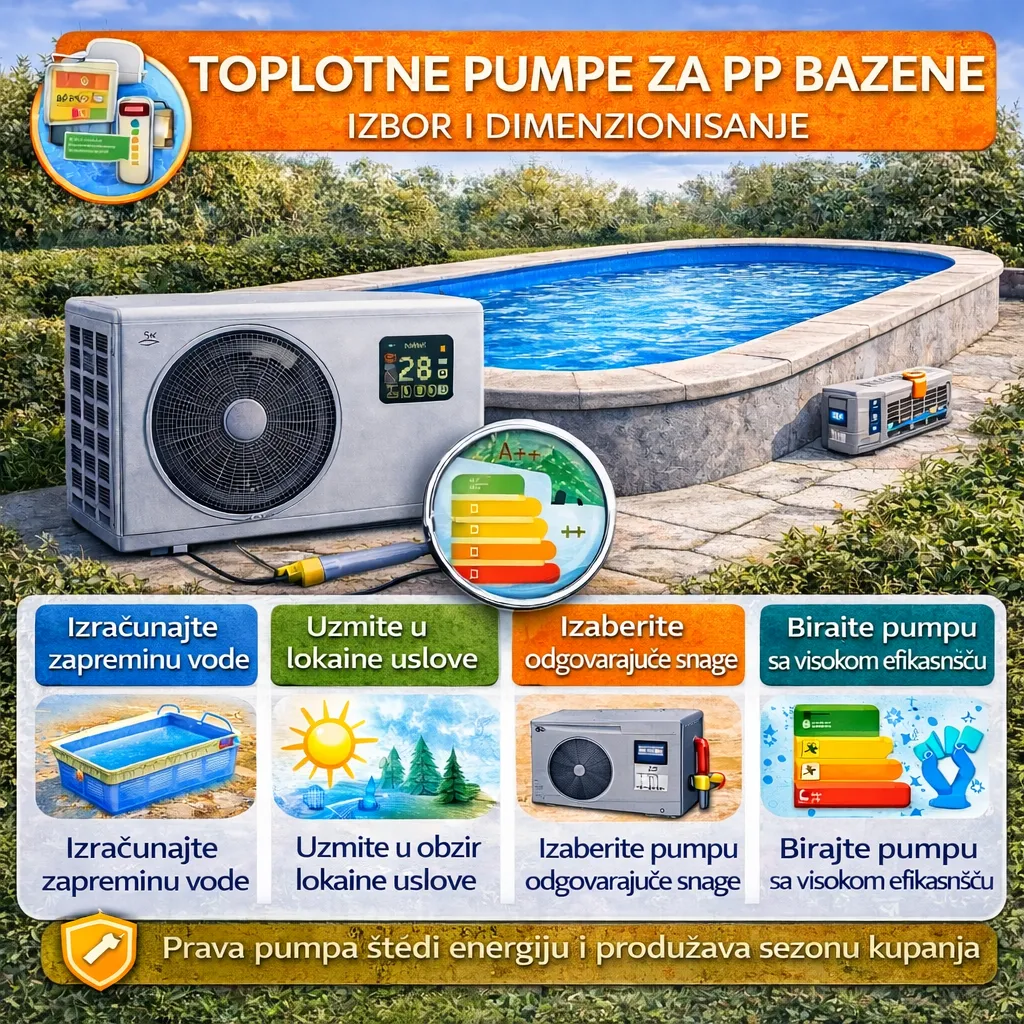
A heat pump is the most common choice for heating private PP (polypropylene) pools, as it offers the best balance between energy consumption and output. However, for it to perform correctly, the pump must be properly selected and sized. An undersized unit will be unable to reach the target temperature or will run continuously, whilst an oversized unit may cost more than necessary.
How does a pool heat pump work?
A pool heat pump "extracts" heat from the air and transfers it to the water via a heat exchanger. It performs best when outdoor temperatures and conditions are favourable and heat losses from the pool are kept to a minimum (insulation + thermal cover).
What affects the required pump output?
pool volume (m³),
desired target temperature (e.g. 27–30°C),
how quickly you want to heat the pool (number of days),
period of use (spring/autumn require a more powerful unit),
pool insulation (base and sides),
whether a thermal cover is used (the most important factor for losses),
location and microclimate (wind, shade, altitude).
The golden rule: cover + insulation
The greatest heat losses occur through the water surface via evaporation. A thermal cover can halve losses or reduce them even further. This is why a cover is practically essential equipment if you want efficient heating. A PP pool with insulated base and side walls further reduces losses and speeds up achieving the target temperature.
Sizing in practice
The simplest approach: start from the pool volume and the desired period of use.
Summer season (June–August): a "comfort" output level is sufficient, as the air is warm.
Extended season (May–September): requires a more powerful pump or an inverter model with a wider operating range.
Early spring / late autumn: demands the most powerful pump and good insulation + cover, otherwise heating becomes uneconomical.
Inverter vs ON/OFF heat pumps
ON/OFF pumps run at full power or switch off. Inverter pumps modulate their output and are often quieter and more economical in real-world operation, particularly when maintaining temperature. For private PP pools, inverter models are often the better choice if greater comfort and lower running costs are desired.
What to consider when selecting?
Operating temperature: how well does it perform at 10–15°C outdoor temperature (important for spring/autumn).
COP / efficiency: the ratio of heat output to energy consumption (realistic under operating conditions).
Noise level: particularly important in gardens close to neighbours.
Matched flow rate: the pump must have a flow rate suited to the filtration system and pool hydraulics.
Installation position: unrestricted airflow, not enclosed in a "box".
Mistakes that cause problems
purchasing a pump "by feel" without considering volume and season goals,
heating without a thermal cover (major losses),
incorrect flow rate and poor hydraulic connection,
poor pump positioning (restricted airflow, excessive noise).
Conclusion
A heat pump is the best heating solution for most PP pools, but success depends on correct sizing and reducing heat losses. The thermal cover and insulation are critical first steps, after which the pump is selected based on pool volume, target temperature, and planned season. When everything is done systematically, the result is a stable temperature, a longer season, and economical running costs.