
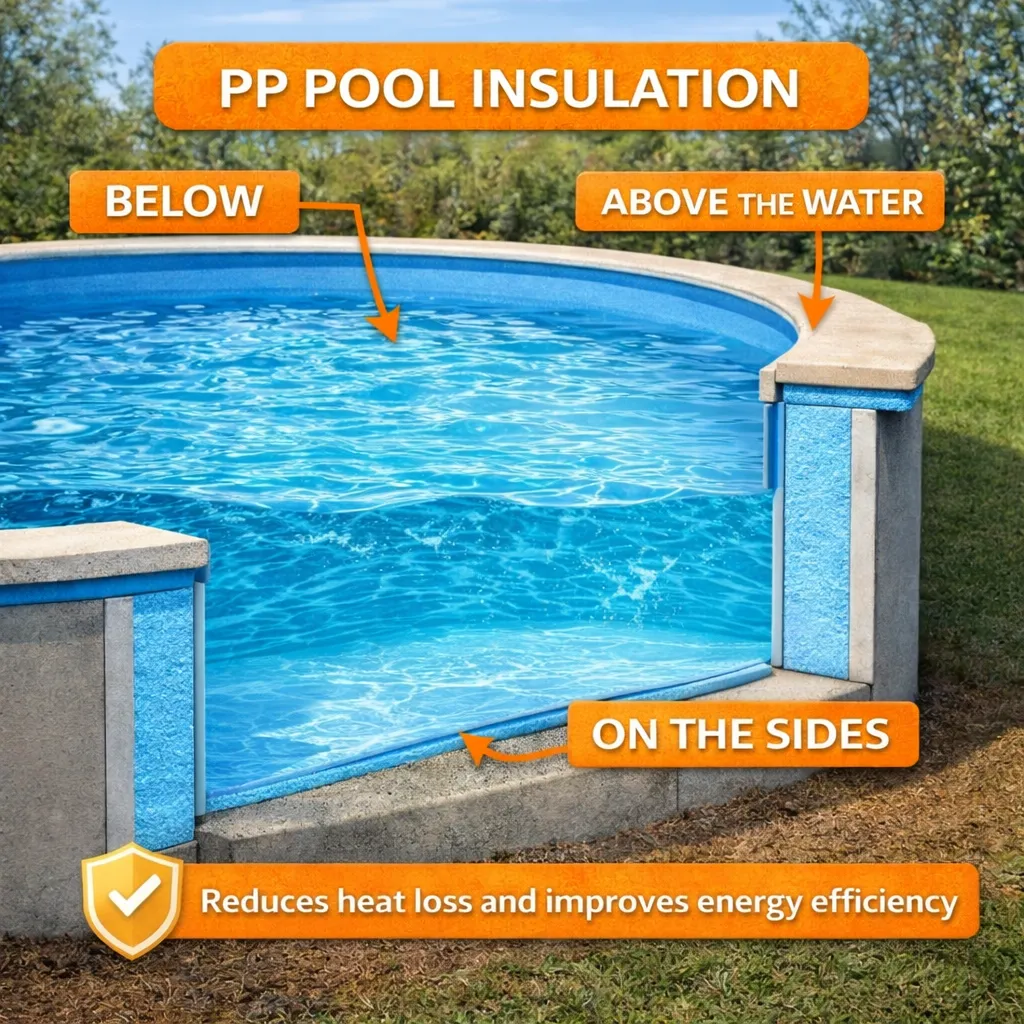
Insulating a PP (polypropylene) pool is one of the most important factors for comfort, stable water temperature, and rational heating costs. The PP pool itself is not a "thermal insulation" — it is a structural material. Real savings and comfort come when insulation is correctly installed: beneath the pool, on the sides, and in the zone above the water level.
Why is insulation important?
lower heat losses and reduced heating costs,
faster attainment of the desired water temperature,
more stable temperature overnight and in windy conditions,
greater comfort during an extended season (spring/autumn).
Bottom insulation (floor)
Floor insulation reduces heat loss into the substrate and the ground. XPS (extruded polystyrene, Styrodur) is most commonly used due to its high compressive strength and moisture resistance. Thickness is determined by the design; our pools use 2 cm as standard.
Key requirement: a flat and stable substrate, XPS boards correctly laid with no gaps.
Side insulation (walls)
Side insulation reduces heat loss through the pool walls and supports more stable operation of the heating system. EPS (expanded polystyrene) or XPS is commonly used, depending on the installation conditions. In practice, approximately 5 cm or more is frequently used; the choice depends on the construction method, backfilling, and soil moisture.
Key requirement: protection of the insulation during backfilling, correct bonding, and continuity of the layer.
Zone above the water level (thermal bridges)
The part of the pool above the water level (edges, overflow channels, upper wall zone) is often the area of greatest heat loss. Thermal bridges form here, particularly in overflow pools and at complex edges. Correct insulation of this zone supports temperature stability and reduces condensation and cooling.
Combination of insulation and pool cover
The greatest heat losses occur through the water surface (evaporation). For this reason, a thermal cover frequently makes the biggest difference. The best results are achieved with the combination: floor insulation + side insulation + thermal cover.
Most common mistakes
insulation on the sides only, without floor insulation,
use of materials that absorb moisture or lack sufficient compressive strength,
breaks in the insulation layer (gaps),
damage to the insulation during backfilling,
heating the pool without a thermal cover.
Conclusion
Insulating a PP pool is a sound investment that directly affects comfort and running costs. The best results come from floor insulation (XPS), side insulation (EPS/XPS), and addressing the zone above the water level, combined with a mandatory thermal cover. When insulation is done correctly, the PP pool heats up faster, retains its temperature longer, and the swimming season becomes considerably longer and more enjoyable.