
Why is insulation important for PP pools?
For polypropylene (PP) pools, proper thermal insulation isn't a "luxury add-on" but part of professional installation. The PP shell is placed on a reinforced concrete foundation slab, and the space between pool walls and earth is typically stabilized with concrete or appropriate filling according to the project. In this assembly, insulation has a clear task: to reduce heat loss, stabilize operating conditions and improve long-term system efficiency.
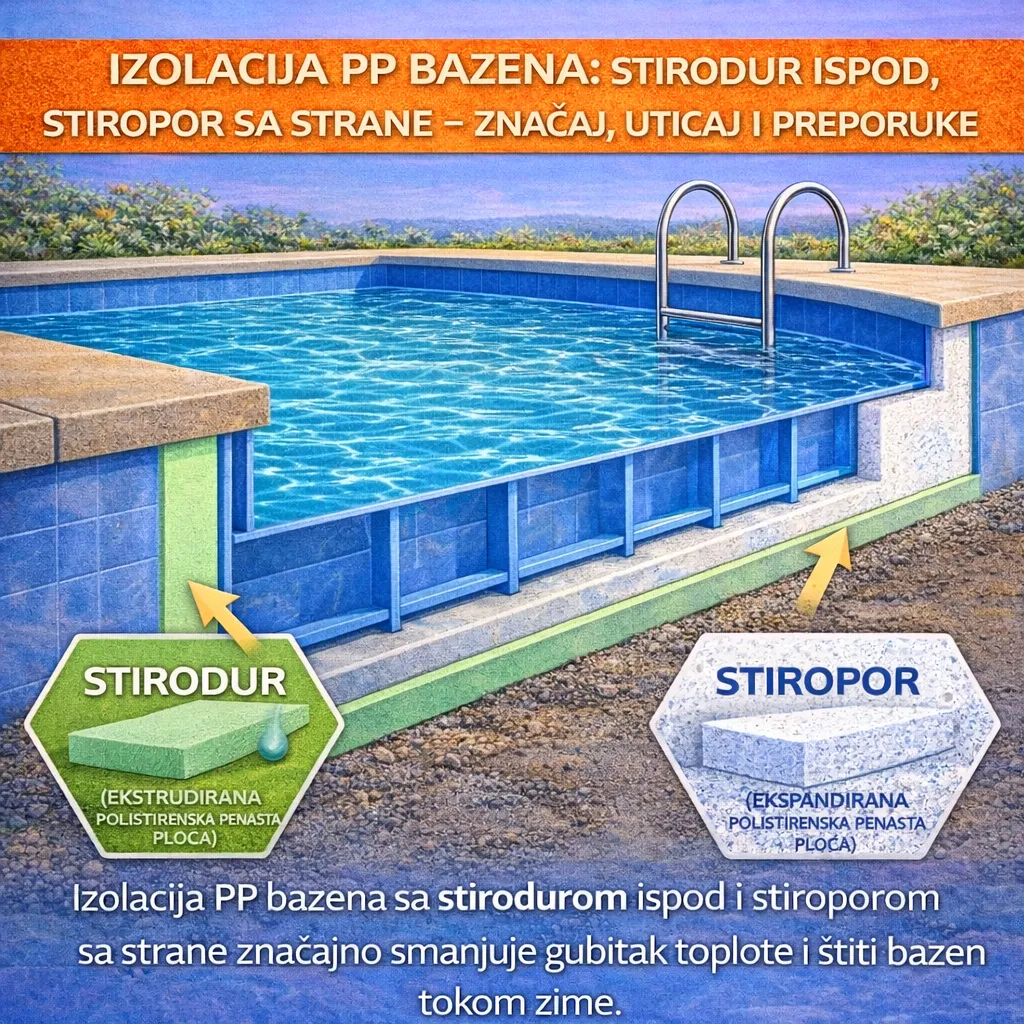
Our practical recommendation: 2 cm XPS (extruded polystyrene) underneath the pool and 5 cm EPS (expanded polystyrene) on the sides. This ratio provides an excellent balance of cost, performance and real installation conditions for residential PP pools.
Water is a large "energy reservoir". When the pool is heated (heater, heat pump, solar), any unnecessary heat loss means higher bills and slower achievement of desired temperature. The most common losses in private pools occur through:
- water surface (evaporation – a cover helps here),
- bottom and sides (contact with colder concrete and earth),
- installations and equipment room (poor pipe/room insulation).
Insulation of the bottom and walls reduces heat flow from water to concrete/earth, moderates temperature fluctuations and helps the heating system work more stably and economically.
XPS (extruded polystyrene) underneath the pool – why this material?
For insulation underneath the pool, we choose XPS because it's designed for conditions with higher loads, potential moisture and need for stable mechanical resistance. XPS has a closed-cell structure, handles pressure well and maintains insulation properties in real-world conditions.
Recommended thickness underneath: 2 cm XPS
A thickness of 2 cm is practical and often optimal for residential PP pools: it's enough to break the cold bridge to the concrete slab, without unnecessarily raising the pool level and complicating installation details. Combined with good water coverage (roller/cover) and correct hydraulics, this insulation delivers visible effect on energy consumption throughout the season.
EPS (expanded polystyrene) on the sides – when is it a good choice?
For pool sides, EPS is commonly used in practice because: it's more affordable, easy to install, easy to cut and adapt, and provides good thermal effect when properly installed. On the sides, loading is handled by the stabilization system (concrete/fill) according to the project, so EPS makes good sense here.
Recommended thickness on sides: 5 cm EPS
A thickness of 5 cm on the walls is an excellent "sweet spot": enough to significantly reduce heat loss toward the earth, while remaining cost-effective and simple to install. It's particularly useful for heated pools and locations where nights are cooler or the season is longer.
Which EPS do we recommend?
When choosing EPS, choose responsibly. The recommendation goes toward higher quality EPS (higher density/strength) compared to the cheapest variants, because pool sides work in real conditions (moisture, fill/concrete pressures, seasonal changes). Higher quality EPS deforms less, is more stable and maintains performance better long-term.
In practice, the goal is for the insulation layer to remain uniform, without "empty pockets" and without local settling. This directly affects thermal bridges, but also the feeling of stability around the pool in the backfill zone.
Insulation impact: warmth, comfort and consumption
Insulation doesn't work magic, but it does work math. Lower heat losses mean:
- faster heating of the pool,
- slower cooling during nights and cooler days,
- less heater/heat pump operation,
- more stable water temperature, which is noticeable in swimming comfort.
The greatest effect is achieved when insulation is combined with a cover (reduces evaporation) and correctly sized filtration and heating. For heated pools, bottom and wall insulation practically "pays for itself" through lower energy consumption.
Important installation notes (for insulation to actually work)
- Flat and prepared substrate: XPS boards underneath must lie flat, without waves and voids.
- Layer continuity: board joints are fitted carefully, without large gaps.
- Protection from damage: during installation, boards must not be broken or crumbled.
- Installation details: penetrations and pipes are handled so as not to create unnecessary "thermal short circuits".
- Following fill specifications: side stabilization (concrete/fill) is done according to professional standards.
Conclusion: 2 cm XPS + 5 cm EPS as a rational, professional combination
For most residential PP pools, the combination of 2 cm XPS underneath and 5 cm EPS on the sides is an excellent solution delivering real benefits: better thermal stability, lower energy consumption for heating and better comfort. If you're planning heating, a longer season or have a cooler location, insulation is an investment that pays off fastest in practice.
Note: Every installation should respect specific site conditions and the project (foundation slab, structural design, fill, drainage). If you'd like, we can suggest the optimal solution for your pool based on dimensions and location.