
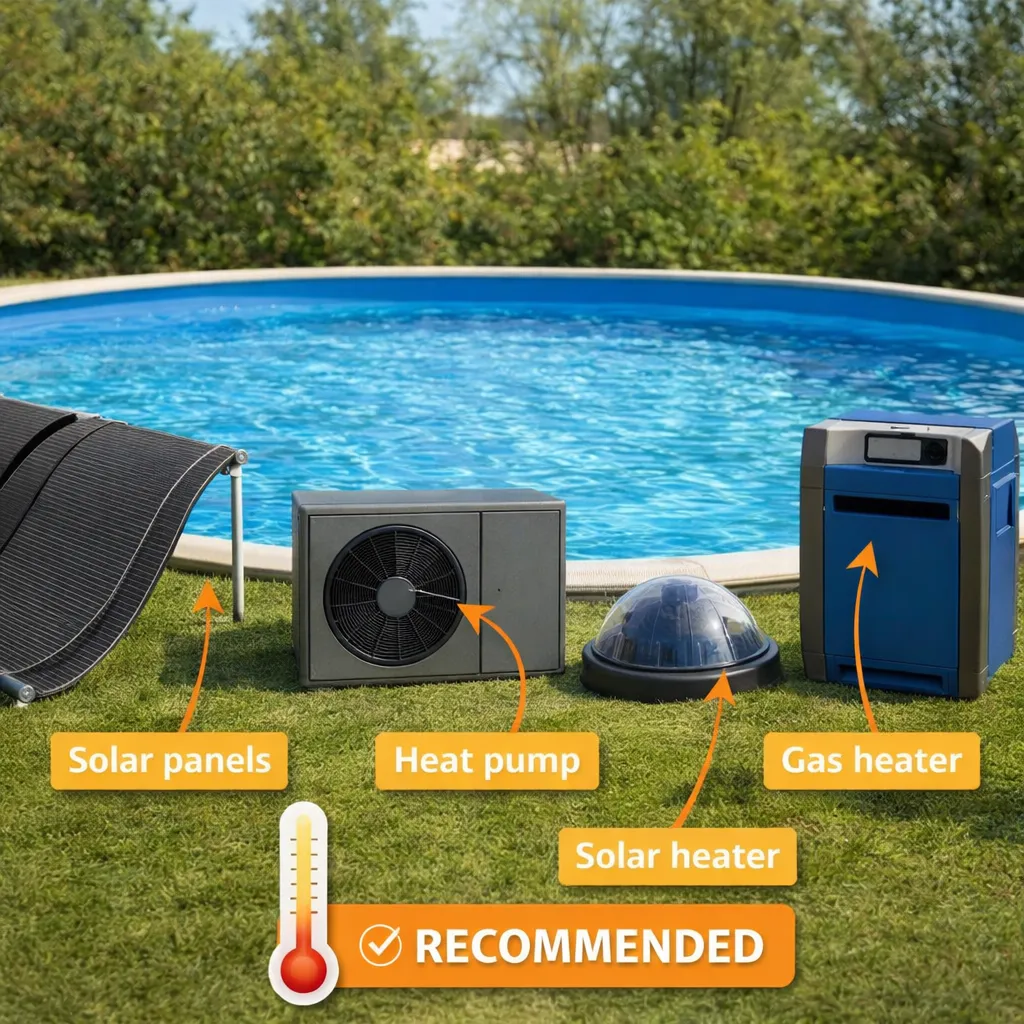
Heating is one of the most important considerations if you want a longer swimming season and stable comfort in a PP (polypropylene) pool. In practice, without heating, most private pools are realistically usable for no more than 2–3 months, whereas with good insulation and a smart heating system the season can be significantly extended. PP pools provide an excellent basis for heating: the system is straightforward to design, and insulating the base and side walls reduces heat losses considerably.
What influences water temperature most?
outdoor temperature and wind,
solar radiation,
pool insulation (base and sides),
pool cover (summer or thermal),
pool volume and the desired target temperature,
filtration operation and water circulation.
1) Heat pump (most common choice)
The heat pump is, in practice, the most popular heating solution for private pools because of its excellent balance between energy consumption and output. It works by transferring heat from the air into the water. Best results are achieved in combination with a thermal cover and good PP pool insulation.
Advantages: low energy consumption relative to heat output, fully automatic, stable temperature.
Disadvantages: dependent on outdoor temperature, higher initial investment.
Example: heating 30 m³ of water by 1 °C takes about 35 kWh of heat (not counting heat losses). A heat pump draws most of that heat from the air, so at a typical coefficient of performance (COP) of around 5 it uses roughly 7 kWh of electricity; at lower outdoor temperatures the COP drops and consumption rises. That is why a cover and insulation make such a difference to the bill.
2) Electric heater (fast, but expensive to run)
An electric flow-through heater is simple to install and raises the water temperature quickly, but electricity costs can be high. It is often used as a supplementary or temporary solution, or for smaller pools and spa zones.
3) Heat exchanger (connected to an existing heating system)
A heat exchanger uses energy from an existing home heating system (boiler, domestic heat pump, solar system). It works well when a powerful and stable heat source is available along with good hydraulics. The solution is considered "professional" but depends on the installation and capacity of the domestic system.
4) Solar heating (seasonal supplement)
Solar collectors or solar panels for pools can raise the water temperature, particularly during sunny periods. However, solar heating is variable and is generally not sufficient on its own to maintain a stable temperature. It is most often used as a supplement, in conjunction with a cover.
Most important recommendation: a cover is the "cheapest heating"
Without a thermal cover, the largest portion of heat is lost through the water surface via evaporation. A thermal cover often makes a greater difference than a more powerful heater, because it dramatically reduces losses.
Insulation and the PP pool
A PP pool with insulated base and side walls has significantly lower heat losses. This means faster attainment of the target temperature, fewer heating cycles, and lower running costs. Insulation + cover + heat pump is the most common "golden combination" for private PP pools.
How to choose a heating system?
define your target temperature and season length,
take pool volume and insulation into account,
plan for a cover as a mandatory item,
choose the system based on your budget and available energy source (electricity, boiler, solar).
Conclusion
Heating the water in a PP pool is the best way to make the pool a long-term, comfortable asset. For most private pools, a heat pump combined with a thermal cover and good insulation delivers the best price-to-performance ratio. The key lies not only in the power of the heater, but in reducing losses – which is why insulation and a cover are just as important as the heat source itself.