
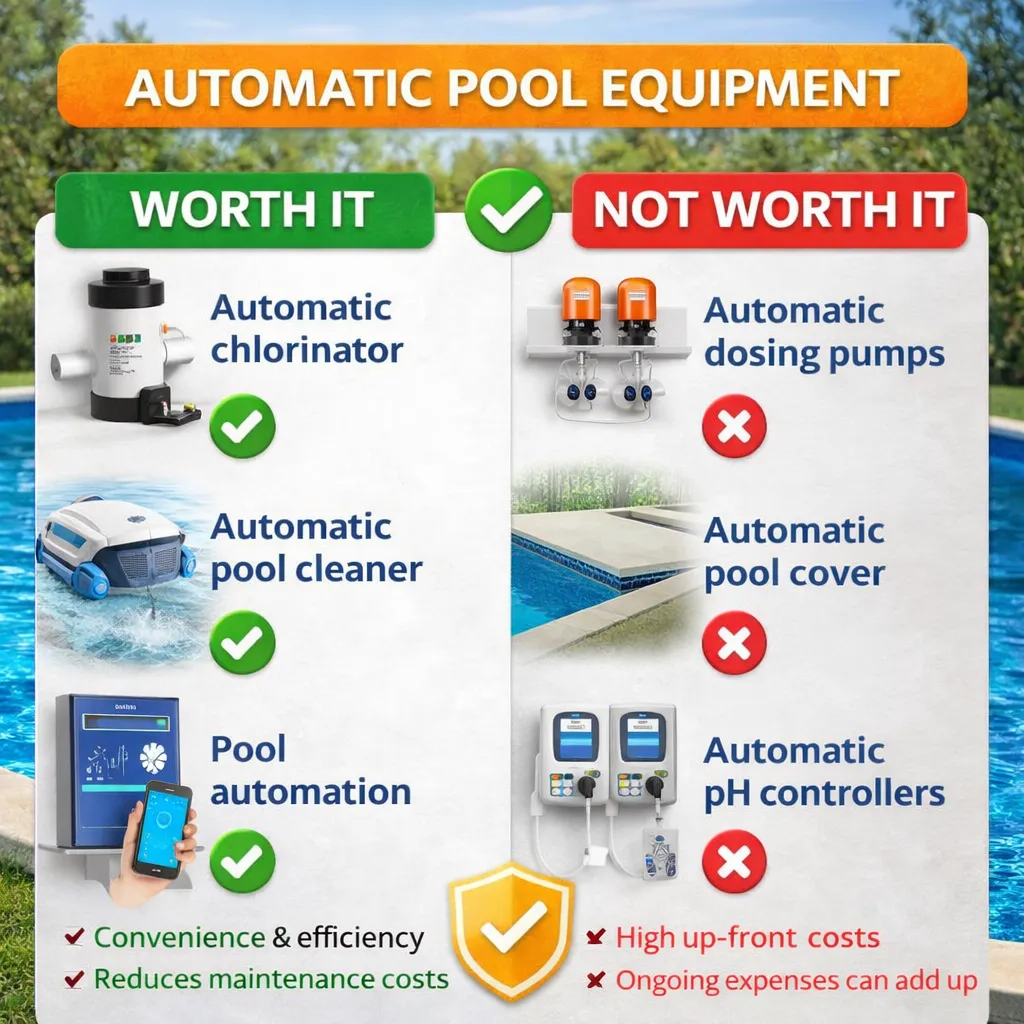
Pool equipment automation can significantly simplify the maintenance of PP (polypropylene) pools, but not every automated system offers equal value for money. The greatest benefit of automation lies in water stability, reduced errors, and less daily manual involvement by the user.
What automation actually solves
stable pH and stable disinfection levels,
reduction in manual work and the risk of forgetting routine tasks,
lower chemical consumption thanks to precise dosing,
consistent water quality throughout the entire season.
What usually pays off
Automatic pH control
Automatic pH regulation is the single most cost-effective form of automation. A stable pH enables more efficient disinfection, more comfortable water, and lower chemical consumption.
Automated disinfection
Dosing pumps for liquid chlorine or smart control of electrolysis maintain a constant disinfection level and reduce the need for frequent manual corrections.
Filtration timers and controls
Simple timers allow optimal pump run times, saving electricity without compromising water quality.
What is often not worth it
Overly complex systems
Complex systems with many sensors and options rarely deliver proportional benefits for private PP pools, but they do increase costs and maintenance demands.
Automation without a solid foundation
If filtration, hydraulics, and the pool cover are not properly sorted, automation cannot compensate for those deficiencies.
Conclusion
The best value for money comes from pH regulation, automated disinfection, and basic filtration control. Everything else should be introduced only when there is a clear need.