
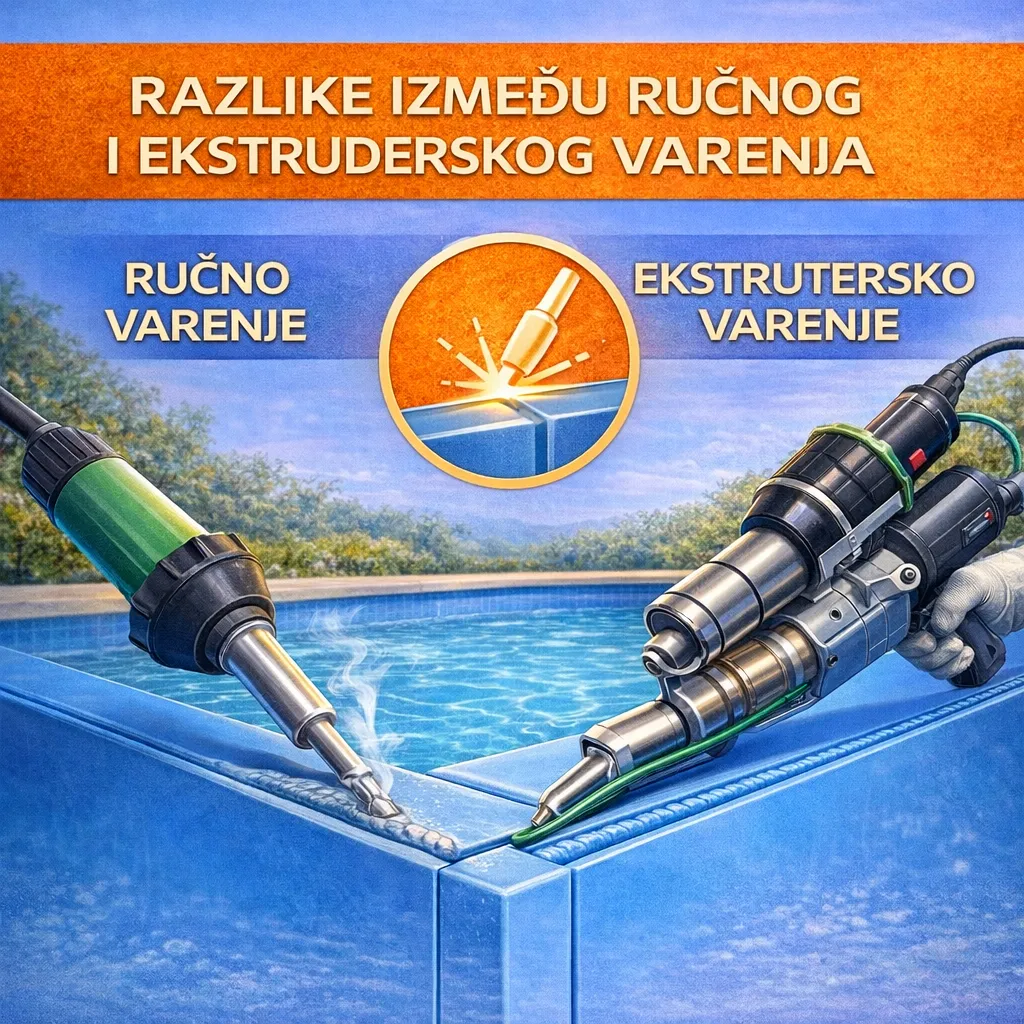
Welding is a critical process in the manufacture of PP (polypropylene) pools, as it directly affects the strength, watertightness, and longevity of the structure. In practice, two technologies are most commonly used: manual welding (using hot air and a welding rod) and extrusion welding. Both methods have their applications, but they are not equivalent in terms of joint strength, working speed, or tolerance for error.
What is manual PP welding?
Manual welding involves joining PP sheets using a hot-air welding tool and a PP welding rod. The material is heated, the rod melts, and is manually pressed into the joint. Quality depends on the operator's experience, temperature control, and correct edge preparation.
Advantages of manual welding
great flexibility and access to complex details,
ideal for internal welds and finishing work,
lower equipment costs.
Disadvantages of manual welding
greater dependence on operator skill,
slower for long structural seams,
higher risk of inconsistent quality.
What is extrusion welding?
Extrusion welding uses a machine that melts PP granules or rod material and forces it under pressure into the joint. The material is deposited in greater volume, creating a more massive weld bead, making it particularly suited to load-bearing and structural connections.
Advantages of extrusion welding
exceptionally high weld strength,
consistent quality along the entire joint,
faster production of large and long welds.
Disadvantages of extrusion welding
more expensive and demanding equipment,
more difficult to execute fine and aesthetic details,
requires a larger working space.
Which method is better for PP pools?
In professional PP pool manufacture, these two methods are not mutually exclusive — they are used in combination. Extrusion welding is used for the main structural joints (floor-to-wall, external welds, reinforcements), whilst manual welding is used for internal welds, details, and finishing work. The highest-quality PP pools are produced precisely through the correct combination of both techniques.
Conclusion
The difference between manual and extrusion welding is not that one is "good" and the other "bad". The difference lies in their intended application. Manual welding delivers precision and aesthetic finish, whilst extrusion welding provides strength and structural integrity. When both methods are used where they belong, the result is a robust, long-lasting, and professionally manufactured PP pool.