
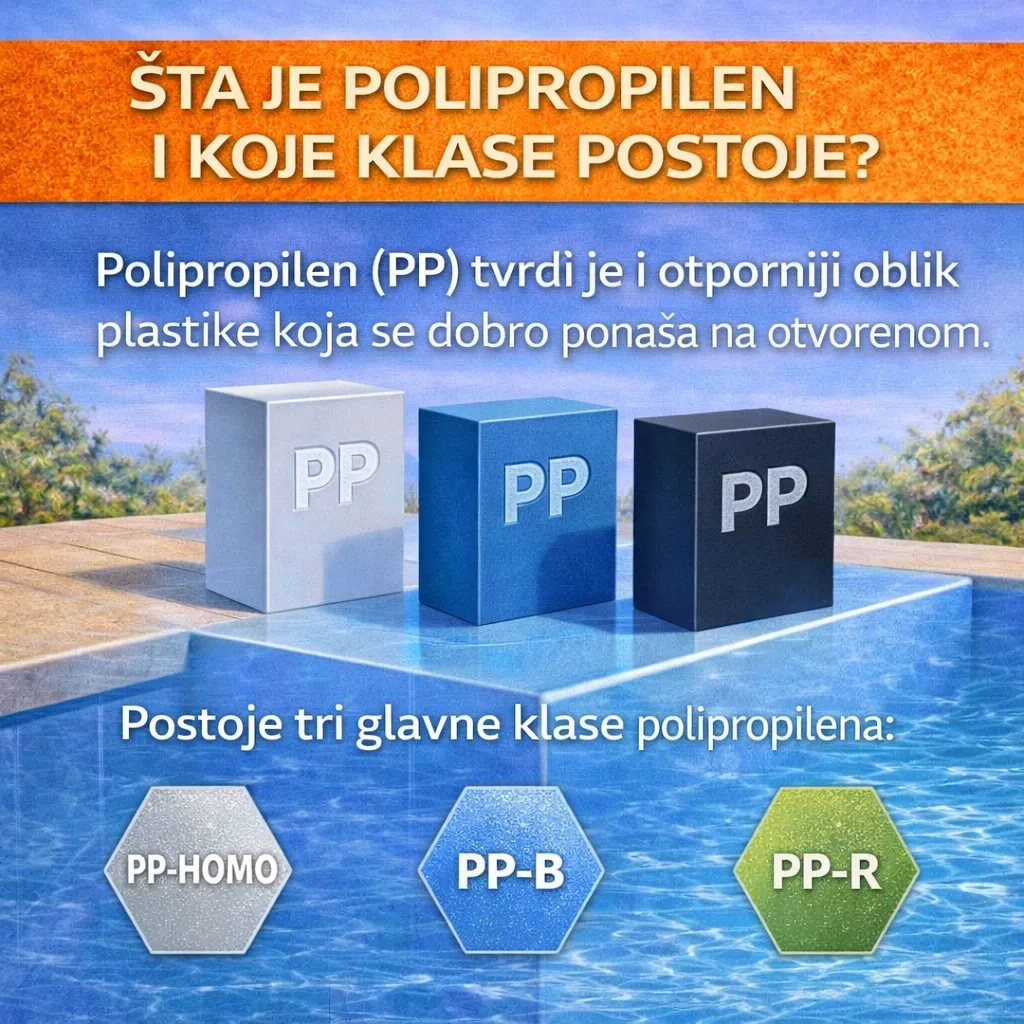
Polypropylene (PP) is a thermoplastic polymer widely used in industry thanks to its chemical stability, mechanical strength, and moisture resistance. In the pool industry, PP plays a special role because it combines several important properties: it does not absorb water, does not rust, does not rot, withstands pool chemicals, and can be welded into a homogeneous, watertight structure.
It is important to understand that "PP" is not a single material of uniform quality. Various grades and formulations of polypropylene exist, and the differences between them directly affect the strength, behaviour at different temperatures, UV resistance, and longevity of the pool shell.
Basic properties of polypropylene
Thermoplastic: softens on heating and can be welded; retains its shape on cooling.
Non-absorbent: does not absorb water and does not swell.
Chemical resistance: withstands standard pool chemicals.
Mechanical stability: with the correct wall thickness and reinforcements it can carry significant loads.
Low weight: lighter than many alternative materials.
Most common polypropylene grades
PP-H (homopolymer)
PP-H is the basic form of polypropylene. It offers good chemical resistance and rigidity but performs less well at low temperatures and under impact. In the pool industry it is rarely used as the primary material for pool shells.
PP-B (block copolymer)
PP-B has better impact resistance than PP-H, particularly at lower temperatures, but is less commonly used for long-term pool shells.
PP-R (random copolymer)
PP-R is the most common choice for high-quality PP pools because it offers a good balance of strength, flexibility, and thermal stability. With UV stabilisation, it represents a reliable material for pool construction.
Conclusion
For serious PP pools, PP-R with UV stabilisation is most commonly used, at the appropriate wall thickness and correctly welded.