
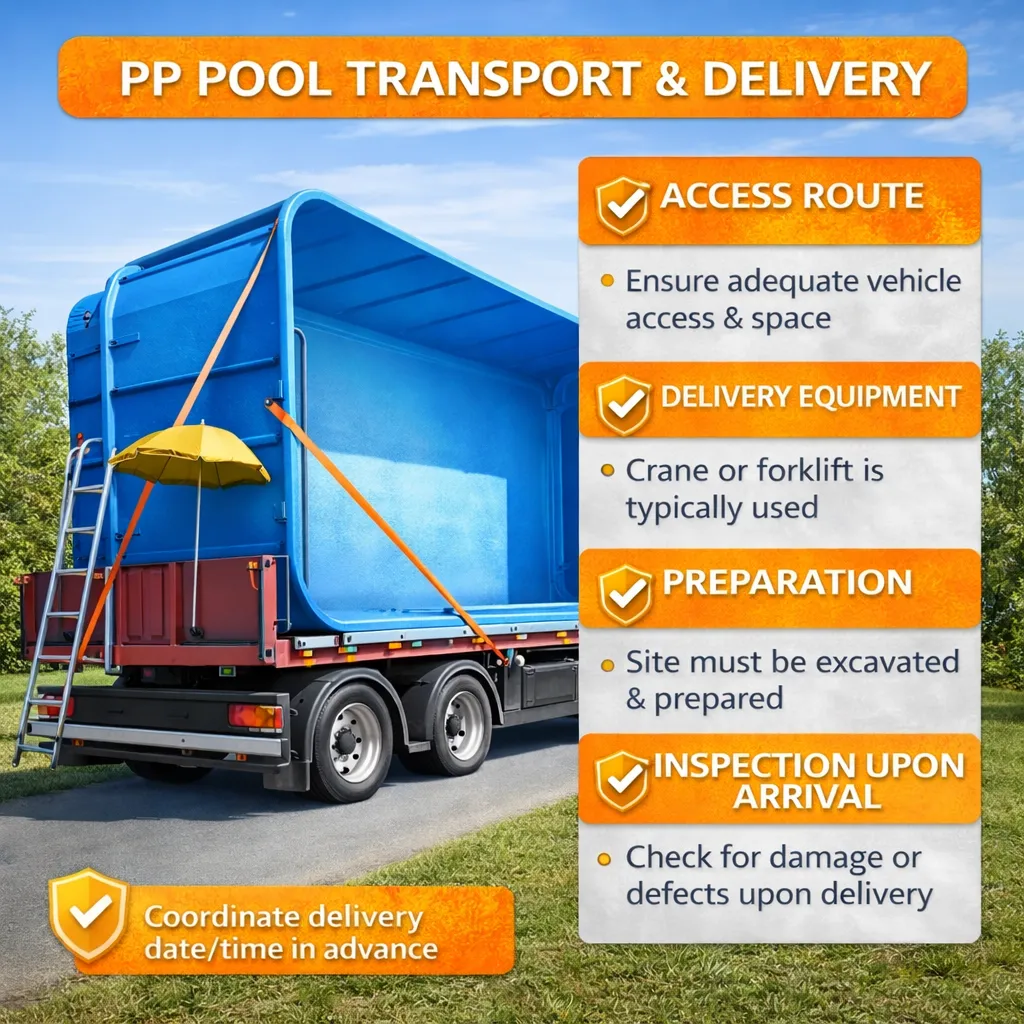
Transport and delivery of a PP pool – what the buyer needs to know
Transport and delivery of a PP (polypropylene) pool are an important part of the project, as the PP pool most commonly arrives as a complete shell or a large prefabricated unit. Good logistics mean less risk of damage, faster installation, and a clear division of responsibilities between the manufacturer and the buyer.
1) How is a PP pool delivered?
In the vast majority of cases, a PP pool is delivered as a complete shell (one piece). This shortens installation time, but requires appropriate transport and access to the site.
2) Site access – the critical factor
The buyer should check in advance whether the lorry can approach close enough to the installation point. Key factors include:
road and gate width,
turning radius,
load-bearing capacity of the ground (to prevent the lorry sinking),
low-hanging vegetation, cables, fences, and other obstacles.
3) Unloading: crane, mobile crane, or hiab
Lowering the pool into position most commonly requires a crane or a lorry-mounted crane (hiab). The choice depends on the weight of the pool, the distance from the lorry to the excavation, and site conditions.
4) Who provides the crane?
In practice, this must be clearly defined in the quotation: whether the crane is provided by the manufacturer or by the buyer. Lowering the pool shell is frequently the buyer's responsibility unless otherwise agreed.
5) Weather conditions and scheduling
Transport and installation are planned so that the pool is unloaded and set in place immediately upon arrival. Leaving the shell on the lorry or in a temporary position increases risk and complications.
6) Protecting the pool during transport
The PP shell is protected against damage (scratches, impacts) and against UV exposure if it is to stand in sunlight for an extended period. Proper securing and support during transport is the responsibility of the carrier/manufacturer.
7) What should the buyer prepare before the pool arrives?
the excavation and concrete base slab completed as agreed,
clear and safe access for the lorry and crane,
a plan for temporarily removing obstacles (fences, branches) if necessary,
the crane booking (if this is the buyer's responsibility).
Most common mistakes
access not checked and the crane cannot reach the site,
insufficient load-bearing capacity of the ground, causing damage to the property,
misaligned scheduling (pool arrived but excavation not ready),
improvised unloading without adequate equipment.
Conclusion
Transport and delivery of a PP pool require thorough preparation: checking access, planning unloading, and clearly dividing responsibilities. When logistics are properly organised, delivery proceeds without risk, and pool installation is swift and efficient.